
(Euspira lewisii)
The Lewis Moon snail is the coastal region’s largest living sea snail, having a shell diameter that can reach 14 cm. The shell is yellowish-white to pale brown, almost round and quite large. The life expectancy is from 2 to 3 years.
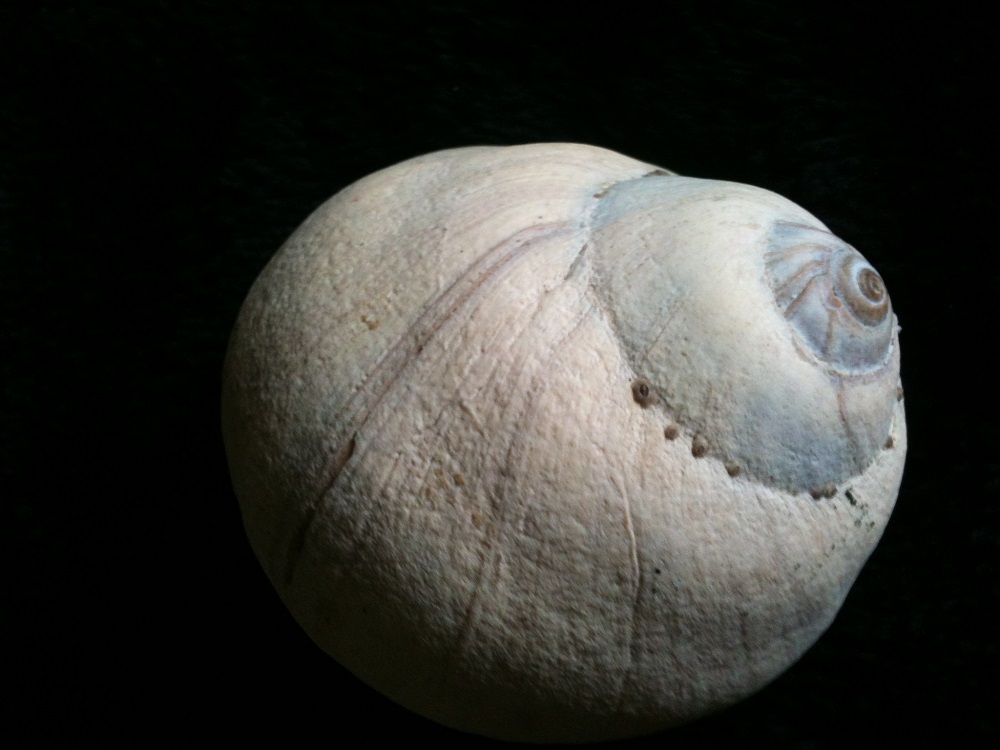
The Lewis Moon snail glides on a very large, mucus-covered foot which, when fully extended, can be up to 30 cm long. When this fleshy mantle is extended, it will nearly cover the Lewis Moon snail shell. The animal can discharge water, which allows it to shrink, slide into its shell and seal the opening by closing its operculum. The snail cannot stay in the shell for long periods because it needs to breathe.

The Lewis Moon snail will feed on clams, mussels, and other various mollusks, and sometimes they will even prey on their own species. They use their foot to clamp onto the clamshell, and using their tongue, they can drill a hole in the clam’s shell. The foot can form a siphon, which they push through the hole and suck up the flesh of the clam.
This animal is unique in its reproduction. In late spring and early summer, the egg case of the Lewis Moon Snail can be found. It is a mixture composed of sand and mucus that forms a single gelatinous ribbon sand collar. In between the layers of this sand, collar are thousands of eggs. As the sand disintegrates over weeks, the larvae are released into the water column. The larvae move into deeper water and feed as herbivores on diatoms and sea lettuce for a while, then switch to shellfish as they grow. When wet, the collar remains quite rubbery and pliable, but becomes brittle when it dries out. Fascinating snail to observe in the wild.