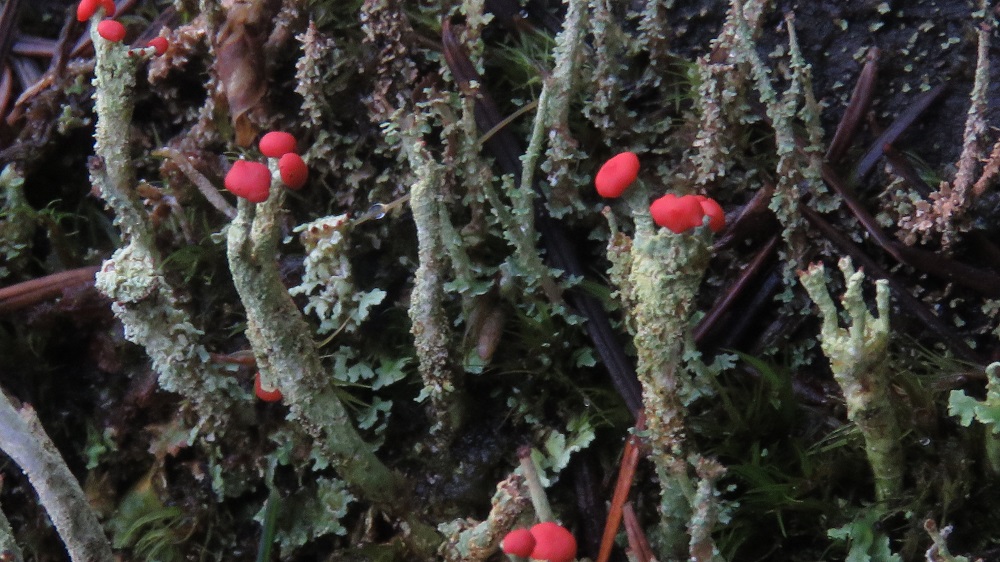
Articulated Coralline Algae
 Articulated Coralline Algae belongs to a group of red seaweeds known as coralline seaweeds. They have a chalky deposit in their cell walls that makes them hard. Coral weed fronds have sections that are ridged but separated by a flexible joint that allows them to move with wave action. The branches usually lie flat, creating a flattened frond, but the shape of these plants can be quite varied. Read More….
Bull Kelp
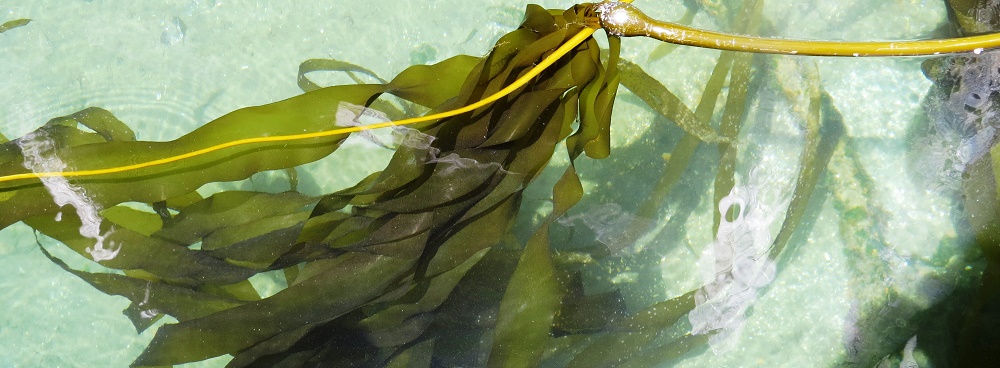 Also known as bullwhip kelp or ribbon kelp. Bull kelp can grow to amazing lengths, with some stalks reaching up to 25 meters and the ribbons reaching a further 4 meters. The bulbs can get to 15 cm around. They can be found growing from Alaska to California, and they grow profusely on all parts of Vancouver Island. This kelp has, over the years, been harvested commercially for both fresh and dried produce for human consumption. Read More….
Green Algae
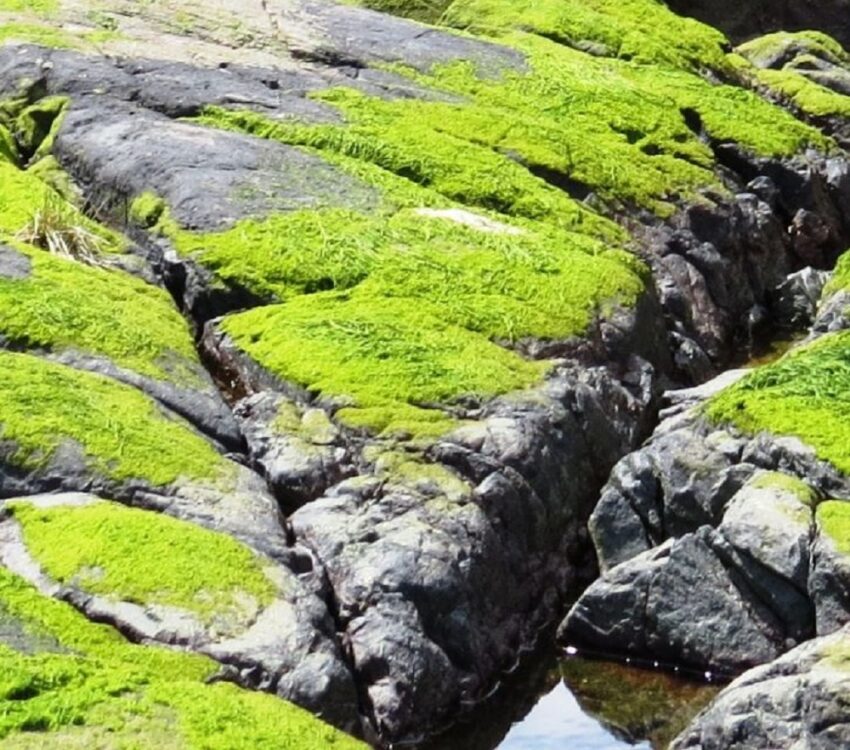 Green Algae can range from one-celled organisms to very large and complex multicelled organisms. They live in large colonies. There are both marine and freshwater green algae species. Green algae could play a role in reducing global warming. As sea ice melts and iron is introduced to the ocean. This fuels the growth of algae, which absorb carbon dioxide, and this could help reduce the effects of global warming. Read More…
Pacific Rockweed
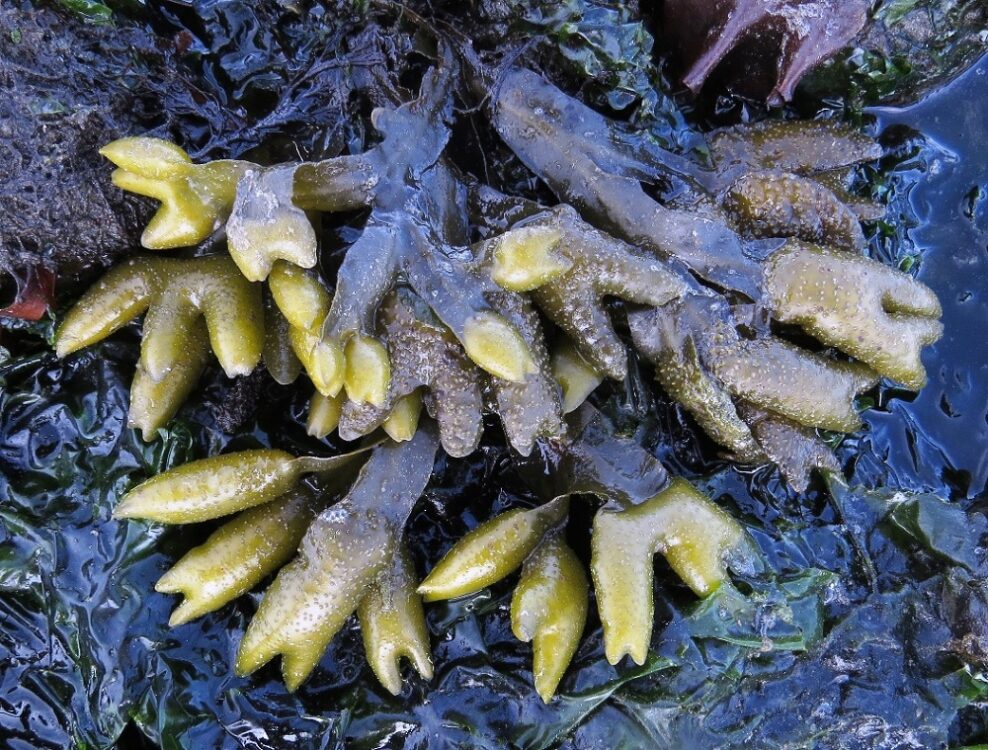 Pacific Rockweed grows all over the BC coastal region; you can find rockweed growing from Northern BC to Northern California. It is a very common plant on the shores of the Pacific Northwest. You can find it growing on intertidal rocky outcrops and on big rock shores. Pacific Rockweed is a light tan olive colour with erect and compact growths with flat stems that branch 2 or more times. Read More….
Sea Lettuce
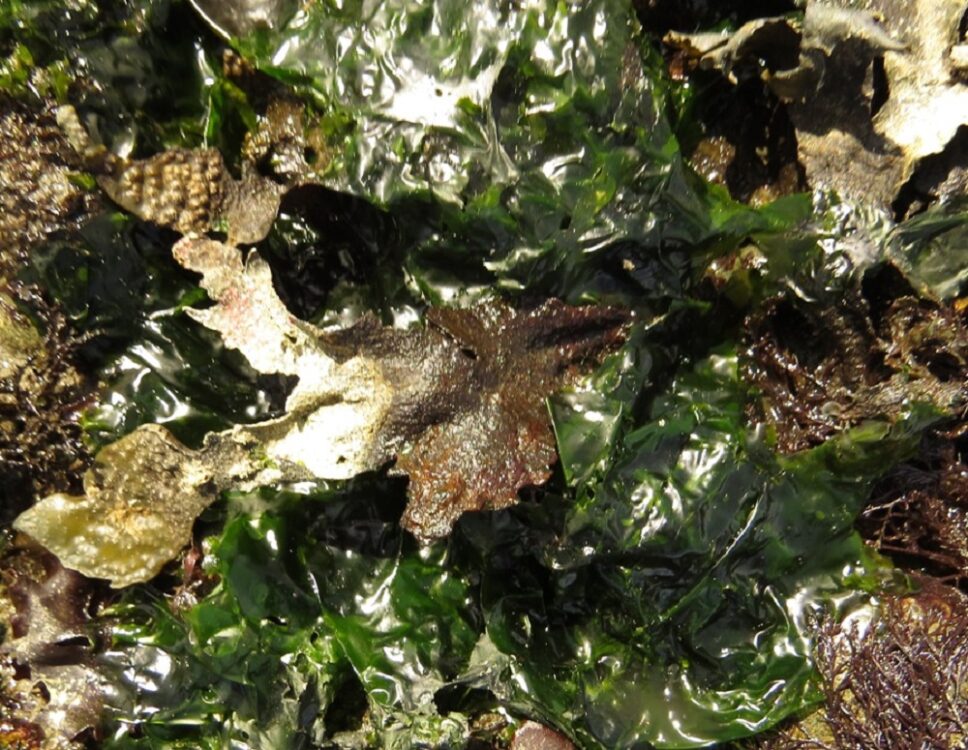 Sea lettuce is a type of green algae. It can be found at low tide on most beaches of the BC coast. Sea lettuce leaves, along with other adrift seaweeds, are deposited on the beach as the seawater retreats. It looks surprisingly like store-bought lettuce. This seaweed is one of some 600 species of seaweed in the Pacific Northwest and is a member of a group that makes up at least half of all living matter on Earth. Read More….
Split Kelp
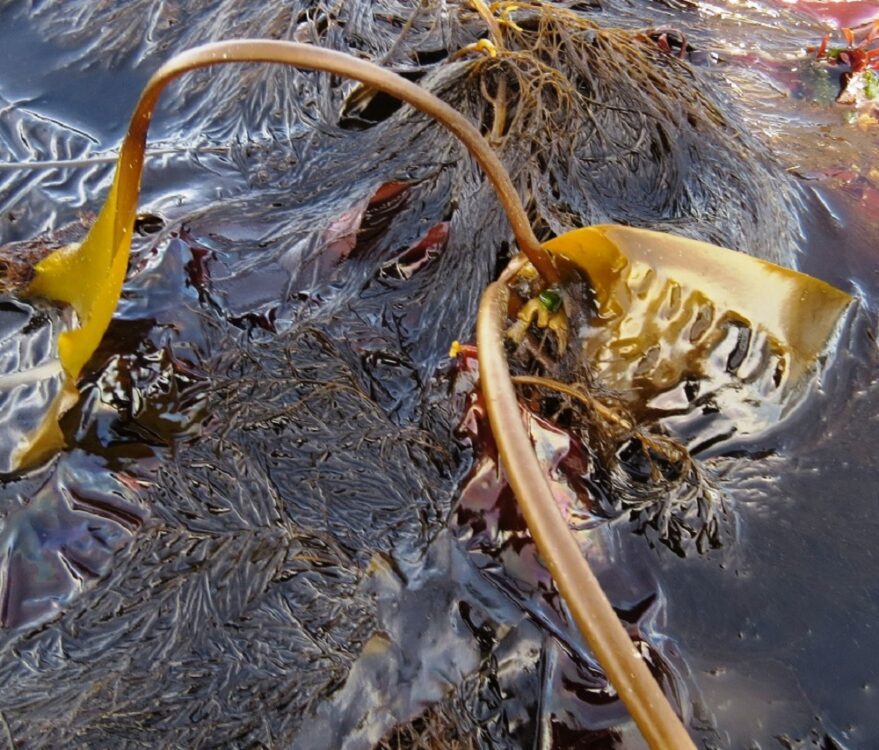 Split kelp is medium to dark brown and has a thallus that is up to one meter tall and a branched anchor that becomes a single stalk. The stalk flattens at its top to become a large flat blade that is divided into several ribbons. It is round-shaped and rubbery to the touch. The blade can be up to 95 cm long and up to 30 cm wide. The stalk can be up to 100 cm long and up to 2 cm in diameter. Read More….
Sugar Kelp
 Sugar kelp is a large brown algae species that can grow to lengths over 2 meters. The kelp has three components: the blade, the stalk (stipe), and the anchor (holdfast), which is used to attach the kelp to a hard substrate like a piling, wharf, or rock. This kelp is usually a dark brown colour with a rippled appearance that makes it look like a lasagna noodle. It also has dimples along the length of its blade on each side. Read More….
Wireweed
 Wireweed attaches itself to rocks or other anchors from low intertidal waters down to depths of up to 6 meters. The plant is normally a yellowish-brown colour and has a short stalk that branches many times with flat leaf-like growths growing at all parts of the stalk that contain all the reproductive components of the plant. This is an invasive plant that first came here from Japan on oyster spat. This plant now grows all over our coast. Read More….
Algae belong to a large group of primitive aquatic organisms. Most of them are autotrophic and are able to carry out photosynthesis. Just like the land plants, they contain chlorophyll, but they do not possess roots or leaves in the way land plants do. Some algae can derive energy from both photosynthesis and from external sources.
These algae carry out photosynthesis but also take up organic matter by osmosis to derive energy, and a few types completely rely on external energy sources for their energy. There are several types of algae: blue-green algae, red algae, green algae, and brown algae. The green algae are the largest group. Algae grow everywhere. There are more than 20,000 known varieties of algae. Algae mainly occupy marine environments, both fresh and salt.
They produce oxygen (87%), which other life, both marine and terrestrial, uses for its survival. Algae are important to humans not just for their ability to produce oxygen, but also for food and medicine. There are many medical uses for algae.

Algae are also used in many sewer treatment facilities. Algae can be used to treat both municipal and industrial wastewater. Algae play a major role in the aerobic treatment of waste in the secondary treatment process. Algae-based municipal wastewater treatment systems are mainly used for nutrient removal (removal of nitrogen and phosphorus). Algae can accumulate heavy metals and thereby remove toxic compounds from wastewater. In some cases, algae also play a role in the removal of pathogens in the tertiary treatment stage.
When algae are grown in sunlight, they can absorb carbon dioxide as they grow, and they will convert the carbon dioxide into oxygen for the rest of us to breathe. This can be used to reduce CO2 emissions from sources such as power plants, ethanol facilities, and other sources.

Algae, like the coralline algae, are important members of coral reefs. Red algae are unusual among the algae because they can produce calcium carbonate, which makes the plant’s walls hard and resistant to wear. Brown algae are found mainly in the tidal zones, but some exist in the deep ocean. Among the brown algae are the largest and most complex of the algae; they include the giant kelp we see growing on the island’s inner waters. They can be more than 70 meters long and are a major food for fish.