

By the fall of 75, I was employed by a logging company on Hardwicke Island. I had been in a few camps by then, mostly trailers set for the various needs of the logger, modern rooms. This camp was different and was pretty cool; it was old school. It was like being in the forties. For example, in the wash house, there was one set of taps. Then there was a long wooden counter that ran down along the wall. There were round holes cut into this countertop with mirrors on the wall above. On the other wall were metal wash basins hanging. You take one down, fill it at the taps and move to one of the holes in the board that fits these basins. When you were done with your washing up, you poured the contents down the drain at the taps and rinsed the basin before hanging it back on the wall.
You were called to meals by a big triangular steel that hung outside the door, where you were always served up man-sized meals. I was just a kid during my time here, but I still remember the old guys upon seeing my plate at dinner time and quite often commenting about where the hell I put it all.
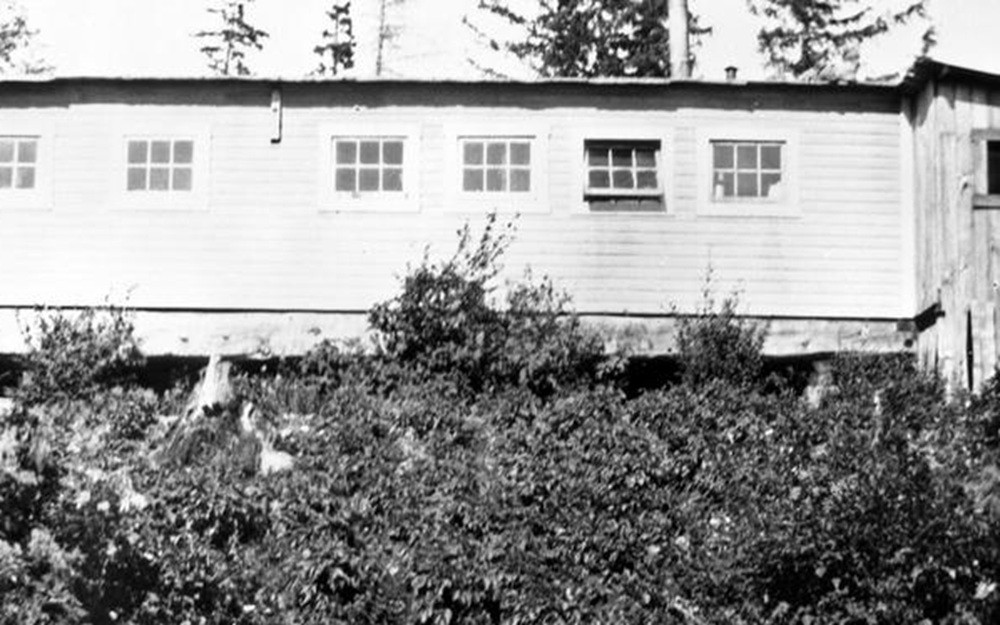
Our bunkhouses were big, round buildings. All the bunks were on the outside, by the walls, with tables and chairs arranged around a central stove, making up the inner part of the room. My first night in camp, I got some really bad leg cramps around 2 am. All the men in my hut were quite old, old-time loggers. They all woke up from my groaning, and they gathered around me, telling me how they beat these cramps. Several told me that they would wear pantyhose, and this worked well. I never tried the pantyhose, but in our crummys was a dispenser for salt tablets. I started using them, and the leg cramps were gone. I can still see the oldtimers as they gathered around me that night, and from then on, they just called me the kid.
One day, as we were heading up the hill to go to work, the fellers came careening around a corner hell-bent for leather and came to a sliding halt beside our crummy. Your donkeys on fire, one was hollering, so we picked up the pace and got up the hill as fast as we could, and sure enough, there was our yarder, burning out of control. The chaser had built a fire the day before in the landing to keep warm, and although he had put it out before we left the site, it must have gone underground and come alive during the night. Landings were usually just pushed up piles of wood and dirt. It was a total loss. The insurance company only covered the machine, but not the pipe, as it sustained very little damage. I assumed we would all be laid off until the new machine made it here, and the pipe moved onto the new rig. Instead of laying off the crew, they put us to various jobs. Although I was not involved with the job, it must have been quite the project, putting the new yarder onto the old pipe.
I had been put in charge of operating the rock crusher at the pit. This quarry consisted of a big rock wall at the end, where we would blast rock loose to feed the crusher. This jaw crusher could crunch up rocks as big as trucks and put out any size of gravel that was needed with just one adjustment.
It was a scary old machine built back in the days of crank starts. The first thing you had to do in the morning was start an old Model T motor by cranking it over by hand. Now, this crank could take your arm off when it kicked back, and the crank handle sometimes would come flying off and bounce around in the engine room, and it was always tough to start. Once it was running, you would use it to turn over the big diesel engine that ran the crusher. There was a small flywheel on the diesel engine and a big one on the Model T. There was a belt between the two that was slack until you used a tensioner pulley that was on a lever; you would hold it tight to turn over the crusher motor, a pretty cool system. Sometimes the Model T would stall, and I would need to do it all over again. After getting the big motor running, you would slacken the belt and turn off the Model T until the next day, when you would go through the same process.
If a big rock got stuck in the jaws, I would go out to the bin and, using a full-length rock drill steel, I would move the rock around until the jaws started to grab it. You had to do this quite often. Most times, it was uneventful. There was one time when I was doing this that the jaws caught the steel, pulling me forward, and I fell forward. This caused my fingers to get caught against the edge of the hopper and the steel. As I let the steel go in pain, it came back and hammered me in the forehead, damn near knocking me out. I fell onto the rocks that filled the crusher receptacle. It’s amazing how fast I got back to my feet and out of the hopper. I retrieved the drill steel, but my hard hat went through and was pretty flat; it was my favourite tin hat. As I said, this was a scary old machine. This old machine was retired not long after I was running it. From my understanding, you can still see where it rests along the road going out of camp.

One day, A road-building contractor who was contracting for the logging company asked me to come to work for him on his rock drill. This was an awesome job. Drill holes for a few days, load with powder, and blow the shit out of stuff. always did enjoy blowing things up, so this appealed to me. So I jumped right at it. Over the next few months, I got pretty good at it. Blew up a lot of rock faces. Built a lot of roads. I can remember sitting out on the boom, which was extended out and up, right against the rock face where we had drilled holes. I would have several cases of dynamite between my legs and blasting caps in my mouth. I would then load and wire up holes to blow the rock away. It was a pretty awesome job. I worked there until the winter shutdown.