
(Cepaea hortensis)
The Garden Banded Snails can have many shell colours, including yellow, red, pink, & olive. As the name implies, the shell usually sports dark brown bands. However, these may be absent in some morphs.
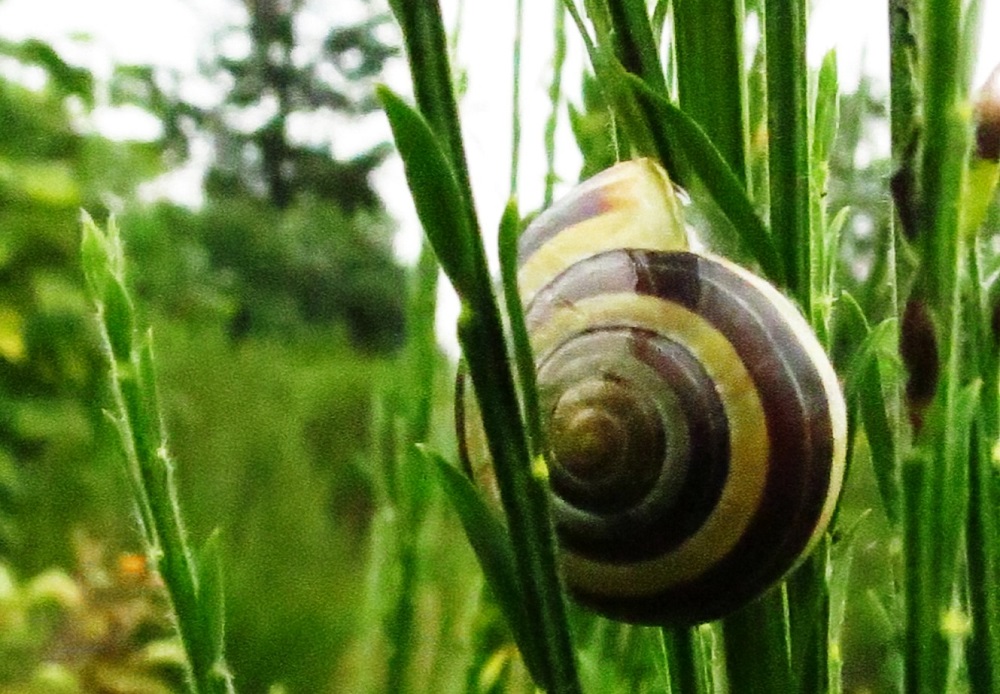
The Garden Banded Snails can have many shell colours, including yellow, red, pink, & olive. As the name implies, the shell usually sports dark brown bands. However, these may be absent in some morphs. If the bands are present, they can vary between 1 and 5 in number. Adult Garden Banded Snails have a reflected, dark brown lip around the aperture of the shell, usually consisting of 5 whorls. These creatures are between 2 and 2.5 cm in size. The colours of these beautiful snails can vary from plain to full-on stripes, sometimes with up to five stripes on each whorl. Pink colours are also a possibility. The Dark-lipped Banded Snail (Cepaea nemoralis) usually has a dark brown lip around the entrance to its shell, while the White-lipped Banded Snail normally has a white lip at its shell entrance.

The Garden Banded Snails live in a variety of habitats and can be found in woodlands, grasslands, meadows, and backyards. Banded wood snails are more active at night than during the day. They eat many types of plants but seem to prefer those that are dead & decaying, such as fallen apples, dead grasses, herbs, and other flowering plants.
Garden Banded Snails can mate many times during the spring & summer months if conditions are moist and warm. Clutches can have as many as 90 eggs, with some reports of over 150. Eggs are laid in moist soil and may require several weeks to hatch. It can take 2 years for a juvenile snail to mature into an adult. This species of snail will use love darts it has created to make love; that’s kind of sexy for a snail.
Garden Banded Snails are invasive snails originally from Europe; they have been widely distributed throughout North America. They are members of the snail family.
I found a couple handfuls when removing broom. I guess I should.. get rid of them?
Before you do, please check this out, https://laidbackgardener.blog/2015/12/01/dont-crush-those-snails-they-may-be-your-friends/.