
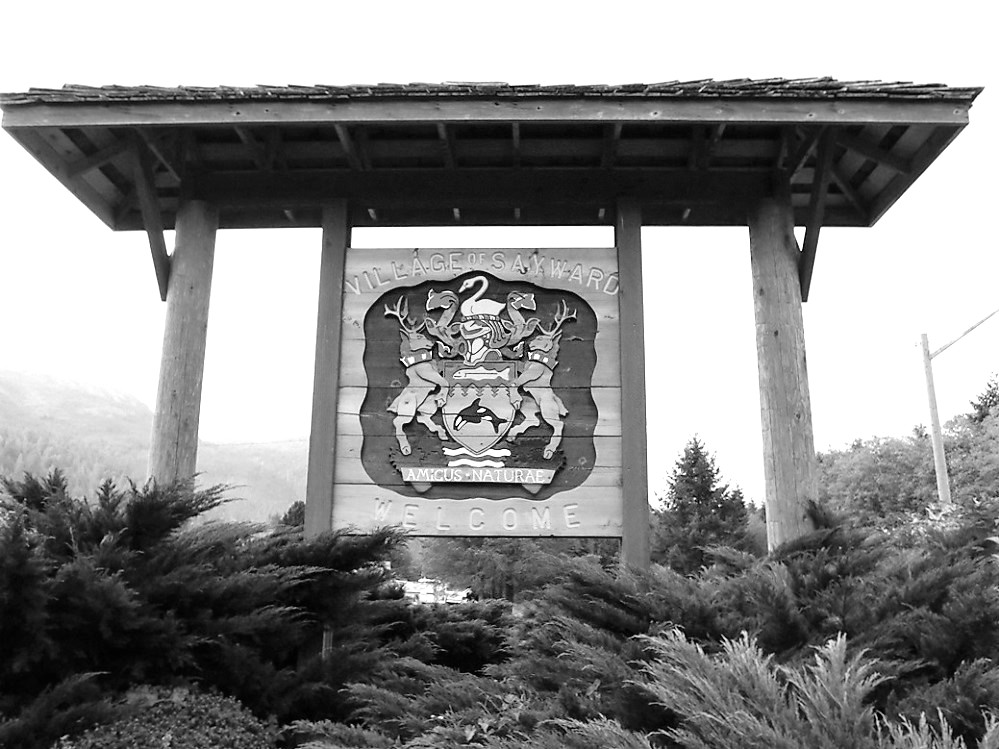
Sayward
In 2015, we moved to the small Vancouver Island community of Sayward. Over the years, my family has had some history in the community. My oldest sister, Peachy, and her husband, Peter, lived here in the ’60s; Pete was a chef at the Mac and Blo camp on the shores of Kelsey Bay, and their children grew up here. Several of my brothers began their logging careers in the camp. My brother Howard worked there in the late 60s, and in 1971, I was hired by the Bendickson Brothers on Hardwicke Island. The island is just across the strait from Kelsey Bay.
When I was still just a kid, my dad and I would drive to Kelsey Bay to take my brother Howard into camp. The road in the 60s was cool with all its twists and turns, especially around the Big Tree Creek crossing. The waterfall located at the crossing was quite impressive, and the road past the bridge followed the Big Tree Creek for a bit as it rushed to join the Salmon River. Between the road and the creek were huge trees that only allowed a glimpse of the tumbling waters as you drove by. These forests of giant trees held me spellbound with wonder. The road was still pretty rough in those days, and depending on the season and the weather, it could take from an hour to several hours to reach Sayward. I loved this drive; sometimes we might see 50 or more deer on the way, and if you were lucky, you could see a bear or two.
Kelsey Bay is located on the northwest edge of the Salmon River Estuary and is accessed by a 12 km paved road off the Island Highway. It is under one hour from Campbell River in the south and about 2 hours from Port Hardy to the north. The Bay can also be reached by boat via the Johnstone Strait. As with all communities on northern Vancouver Island, Sayward had only been accessible by water in the past. It was not until after World War II that a gravel road connecting the Sayward Valley and Kelsey Bay with Campbell River was built. In 1979, the road was improved and extended to the north island from Sayward Valley.

Sayward in 1965 became the southern terminus for the B.C. Ferries Inside Passage route; this brought some much-needed improvements to the road from Campbell River. Then, in 1979, when Highway 19 was extended north to Port Hardy, the terminal was moved to Port Hardy. Sayward is now a put-in point for sport fishing and tourism. There was a road back in the 60s that took you out to Port Kusam. From there, you can access a wonderful area of islands and inlets; it was a great place to put in a boat or kayak, and a great place to start a wilderness adventure that you will never forget. You can no longer drive this road, but it’s still a great way to hike out to the port and its beaches. At one time, there was a hotel and a post office located at the port. Remnants can still be seen.
Fall and winter are good times to visit the Salmon River estuary to view winter waterfowl. Spring is a delightful time to visit due to the prolific nesting around the mud flats. At one time, the Salmon River estuary was home to the island’s largest wintering population of Trumpeter Swans; I can remember seeing them in huge flocks. But you are lucky to see any now.
The village maintains several paths in the estuary to make your viewing experience even more special. These trails will take you deeper into the estuary. In the fall, these trails are prolifically lined with many types of mushrooms that come in so many shapes and colours. Be aware that in the spring it is not uncommon to see grizzly bears here, so please be bear aware.

The estuary is made up of approximately 500 acres of intertidal marshes and mudflats, with the river meandering through them. Spruce, Hemlock, Red Cedar, and Fir trees dominate the estuary’s upland areas, and open wet grasslands are predominant along the waterways. Coho, Chinook, Pink, and Chum salmon travel through the Salmon River Estuary on their way to their spawning areas. Cutthroat and Dolly Varden trout can be found here. Some steelhead can be found here that can weigh on the high side of 10 kilos! At one time, this river was one of the highest producers of giant steelhead on Vancouver Island, but now the numbers of returning steelhead are insignificant compared to those runs in the past. I would suspect that the logging industry had a large effect on the decline of this fish species.
Year-round access to sheltered, open waters, filled with insects & vegetation, has made this estuary a very important winter destination for thousands of waterfowl & shorebirds. During winter, birds can be seen in the thousands, including green-winged teals, golden-eye ducks, widgeons, mallards, great blue herons, bald eagles, red-tailed hawks, and numerous shorebird species.
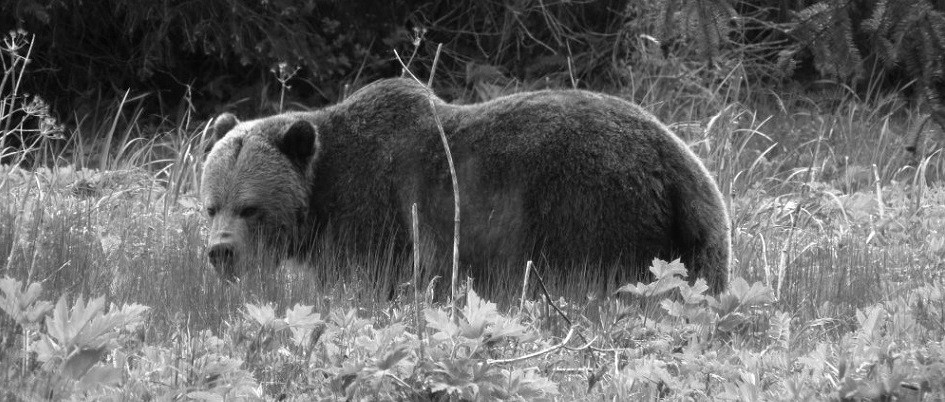
Cougars and black bears can be seen on the south side of the estuary, along with rare but becoming more common sightings of wolves and grizzly bears. The plentiful estuary grass supports a healthy deer and elk population. Just offshore, Orcas and Humpback Whales pass by regularly. I have seen false killer whales a few times here as well. These whales are often thought to be killer whales, but they are smaller and quite black except for gray markings on their throat and chest. They are the fourth largest species of dolphin in the world. All Dolphins are whales, but not all whales are dolphins.
Kelsey Bay Harbour is one of three small craft harbours located between Campbell River and Port McNeil. It is the largest, followed by Browns Bay and Rock Bay. Browns Bay has the most services, with a fuel dock and restaurant. The Kelsey Bay Harbour offers a loading ramp, a derrick, a breakwater system, and a boat launch ramp located at the end of the old BC Ferries’ parking lot. There is another boat launch that can be found at the end of the spit. Rock Bay has a boat launch.

The Salmon River is a popular river for exhilarating river rafting and canoeing in the Sayward community, and the lakes and rivers in the area offer a range of canoeing and kayaking routes. When I was a young man, my friends and I would, in January, put our canoes in at the Salmon River bridge on the Big Tree Creek logging road and spend 4 days canoeing down the Salmon River. We were presented with incredible sights of elk and bears, as well as some of the best fishing around. It was always cold, with snow and sleet, but the river would be running high and with wild rapids, and this is what we were after: These winter rapids were pretty awesome to run.
Another great adventure is the Sayward Forest Canoe Route; it covers almost 50 km of lakes east of Sayward. Some people complete the route in four days, but I suggest you allow a few more days to complete it, as this allows you to really enjoy the sights. Wisdom has it that the best approach to the route is to journey counterclockwise, putting in at the boat launch on Mohun Lake in Morton Lake Provincial Park. There is ample and safe parking here, so no need to worry about that end of things. The well-marked route continues through 10 lakes before returning to the park. Road access to most of the lakes within the canoe route means that paddlers can pick and choose from a variety of put-in and take-out points.
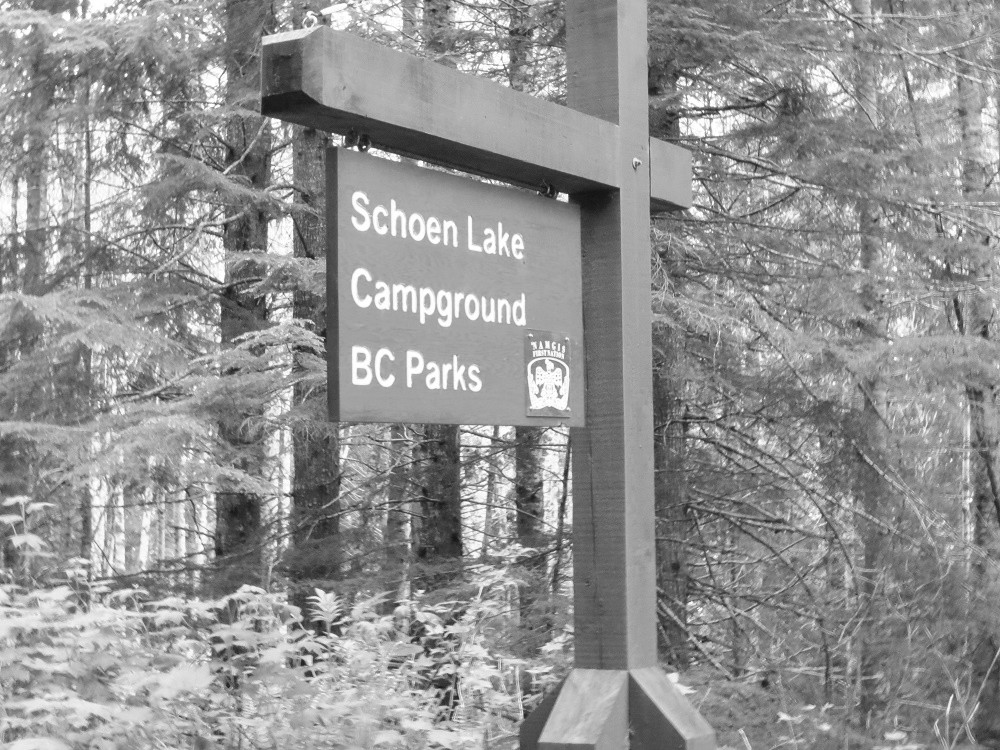
The nearest large provincial park to Sayward is Schoen Lake Provincial Park, considered by some to be the most beautiful camping area and lake on Vancouver Island, offering wilderness hiking, canoeing, fishing, and spectacular mountain scenery. This campground will take your breath away. The mountains in the area are some of the most spectacular on the island.
My new website rebuild is now complete. Did I just say that? In reality, it will never be complete; we are adding new stuff daily, but the rebuild and transition from Askbud to gohiking were finished. My boys and I were constantly out photographing many more areas. I now have a collection of almost 2000 new pages to be added, and this is always growing. It is an ongoing project. Now that I am retired, I can get more done.
I had always wanted to live here in Sayward, and now was the time to just do it. We leased a home in the townsite, packed our house and rented a big moving truck. The move went well; all my adult kids moved with us, so the house we leased was big with plenty of room for the family. Three of our kids- my youngest boy and his girl, Katrina and their 2 kids also moved in with us. It was one big happy family.
Our house was a big house with 4 bedrooms and 2 baths, and a big deck. It was on a corner lot at the top of the hill; it was huge. The yard had a giant ornamental cherry tree that bloomed profusely in the spring with blossoms of pink flowers. This tree would fill up with many kinds of birds that fed on the flowers or the insects that were attracted to them. We had open views of Johnstone Straight and Mount HKusam. Cruise ships would go by, all lit up with lights, making these boats look so close; it was phenomenal. Across the strait from us was Hardwicke Island. There were trails that could take you up the mountains behind the house that seemed to leave right from our yard. Once on these trails, you would encounter mountain streams, old-growth forests, lookout bluffs and a variety of wildlife. The views from up there are incredible.
Cat Bite Fever
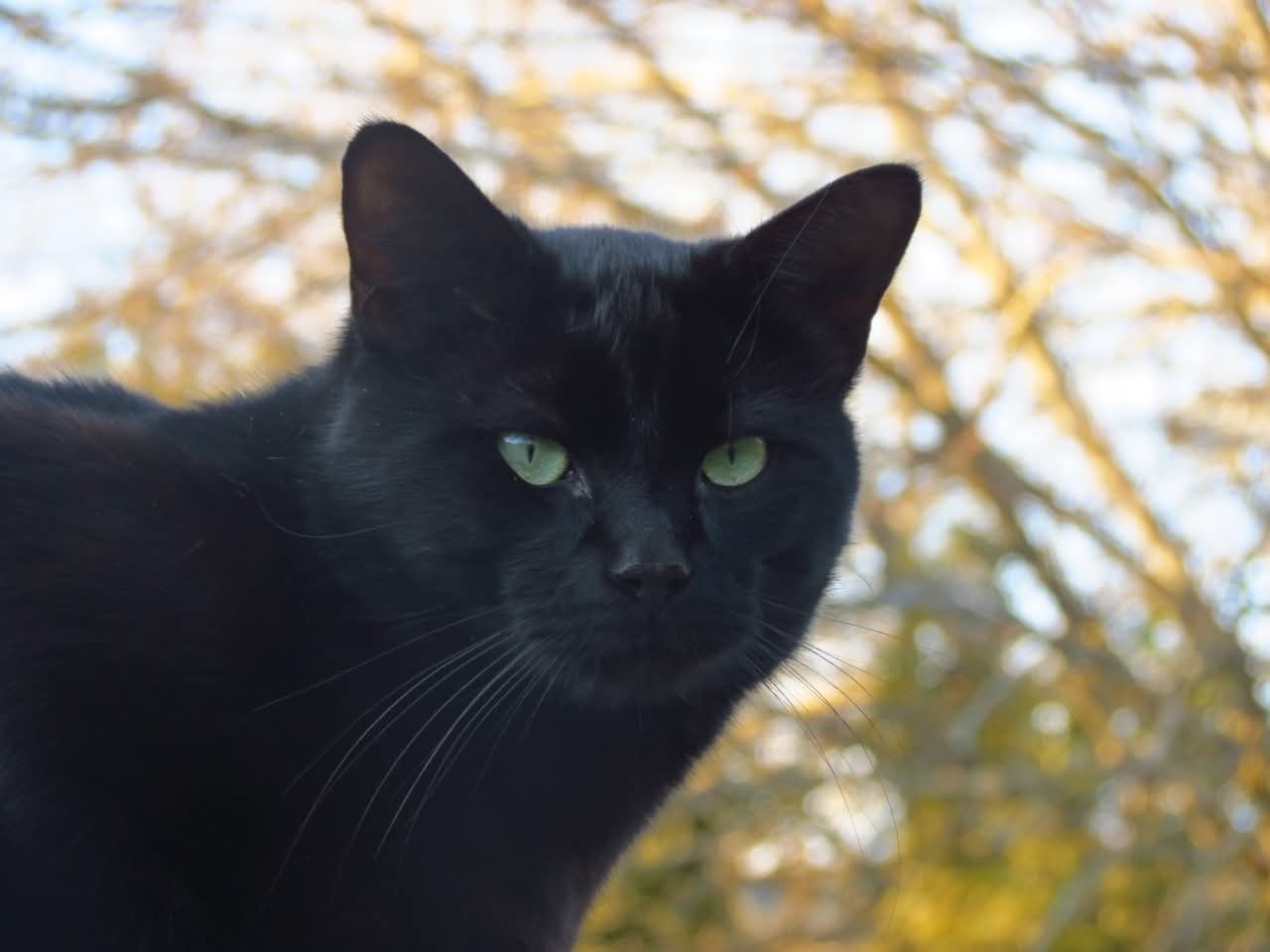
One November morning in 2015, I was having my morning coffee. I became aware of a commotion outside. It sounded like two of my cats were involved in a terrible fight. I threw on my boots to go outside and break it up. We had four cats: a female and a male who had one litter together before we fixed them. We kept two cats, both males from this litter. They grew up being cats that all got along, until one of the young cats and our big male started to fight; it was always brutal. This was another of those fights. By the time I got outside, they had fought and rolled their way into the backyard. The deck out back had canvas attached to form a dry place underneath to store stuff. They had rolled under the canvas and into this area. I entered but could only hear the cats going at it; suddenly they rolled as a ball onto my feet. I just reached down in the dark and grabbed hold of one. As I lifted the one, both came up together before separating. Then the one in my hand turned and viciously bit my hand, sinking its teeth deep. The teeth went right into several sheaths that cover the finger tendons. The other cat ran out; I did not let go of the one whose jaws were clamped on my hand until I was sure the other was gone. Finally I dropped the one in my hand, and it ran out as well. I still do not know which cat bit me. They were both black, and daylight had not come yet.
About an hour later, I was listening to a storm warning on our radio that was calling for a big snowfall later in the day. As I sat there listening intently, I reached for my mug of coffee and noticed my hand had begun to swell up and was almost twice its normal size. I phoned the local clinic, which told me to get down there. The Nurse Practitioner took one look and said I had to go to the hospital in Campbell River. I mentioned the weather warning and the dangers of driving to town during a major snowstorm, but she still insisted that I go; she said people have died from this in as little as 24 hours, and that it was very serious. She was going to phone the hospital to let them know I was coming and that they needed to deal with me quickly so I could get home before the storm hit.
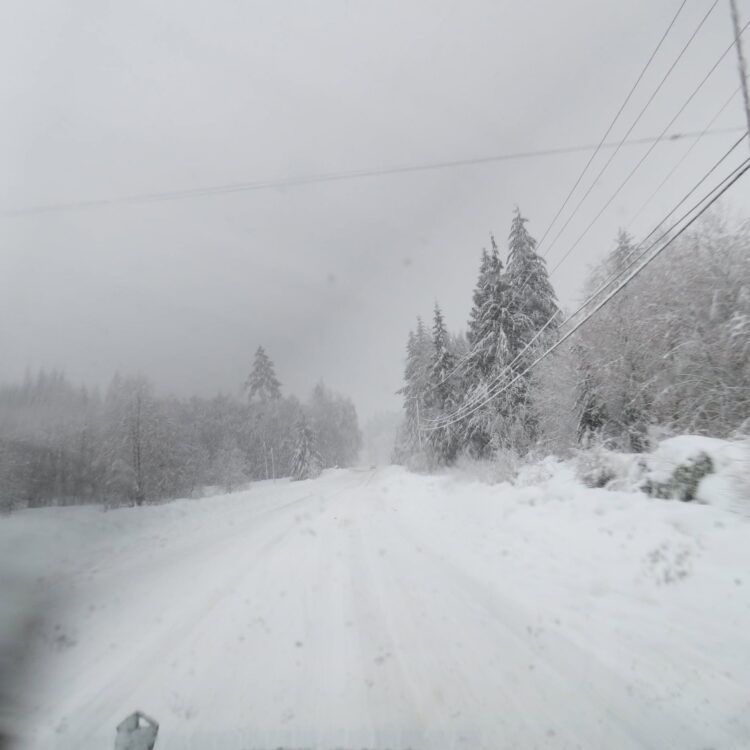
My wife Gina came with me, and off we went. It was a quick run into Campbell, and they did work with me fast. They told me this was a very dangerous situation and it could have turned deadly if I had not come in. Anyway, they got me squared away and phoned a downtown pharmacy to have my prescription ready. We picked this up and were on our way, but we were not fast enough; the storm blew in before we even left town, and the snowfall was heavy. All traffic had stopped, and there was just one set of single-car prints in the snow that was deepening at a fast rate. By the time we reached Roberts Lake, it was more than 12 inches deep. We were in a small Honda. As we were driving past the lake, I began to feel ill and was full of gas that I kept having to burp out, and I was feeling nauseous. As we went past Big Tree Creek, I found myself struggling to keep awake and began to feel like I might black out. We were pushing snow with the car now, and there was little visibility. I was only going maybe 15 km/h. I rolled down my window to stick my face into the falling snow. It was very cold and helped a bit.
By the time we were in the Salmon River Valley, I began to black out. I quickly pulled the car off the road and put it in park. I opened my door and began to puke, big time. I was leaning out the driver’s door puking while, at the same time, a Mounty, who was checking for cars stuck in snowbanks, went by. He stopped, believing he had found a drunk, but quickly realized that I was in extreme distress; he contacted his switchboard and had them dispatch an ambulance to our location. He began to try to help while at the same time comforting my wife, who was having a hard time dealing with this; she thought I might be dying.
The ambulance came from Sayward. They loaded me up; my wife grabbed our gear and came with us as she could not stay there. At the hospital, they began to check me out; it turned out I was allergic to the medication they had put me on, and my hand was still badly swollen. They put me in a room, hooked me up to an intravenous line, and started a different medication. I was there for 3 days.
The police officer who had helped us phoned me in the hospital to talk about my car, as it was a danger to other traffic. It was a Sayward Local officer. After telling him that I would need my car when I got out, and asking if he could please not get it towed, he agreed. After getting out and having a friend drive us to my car, all I found was a big hump in the snow with multiple very large orange cones around it. My car was completely buried. We dug it out and went home.
The Storm

On the morning of December 20, 2018, my wife Georgina and I headed out of Sayward to do some Christmas shopping in Campbell River. There was a wind warning out, but the wind was light, and we even saw a bit of sun on our way to Campbell River. We did our shopping and headed home. The wind picked up a bit around Roberts Lake, and we could see that a few trees had come down, and there were branches on the road. All in all, though, it was pretty calm out compared to what the weather channel had warned could be coming.
Then we turned onto Sayward Road around 5 pm, and there was a police roadblock stopping all cars from going any further. The parking lot at the Sayward junction was full of cars, and even the school bus loaded with kids was waiting. I talked to Kim Graham, who is the head of our RCMP detachment, and she informed me that multiple trees had been blown onto the road from the storm, taking power poles and hydro wires down with them. I asked her if she knew if the logging road into town was blocked, and she told me all town roads were blocked. BC Hydro crews were working to open the road, and we all had to just sit and wait it out. Someone said that there was a crew cutting out the logging road.
As we waited, we could see people going in and out of the co-op gas station with popcorn and coffee; the co-op was giving this out for free. The Crossroads restaurant and pub were also providing coffee, and they were giving free pizza to the kids on the school bus as well. Gives one a good feeling to see our little community helping out like this. Much respect on my part for these businesses.
We had our fill of coffee and popcorn while we waited, and after about an hour, we decided to check out the logging road. There were many trees down, but someone had cut a way through the worst, and we could drive over the rest of them. It was slow going, but we made it to the intersection of the logging road and Sayward Rd.
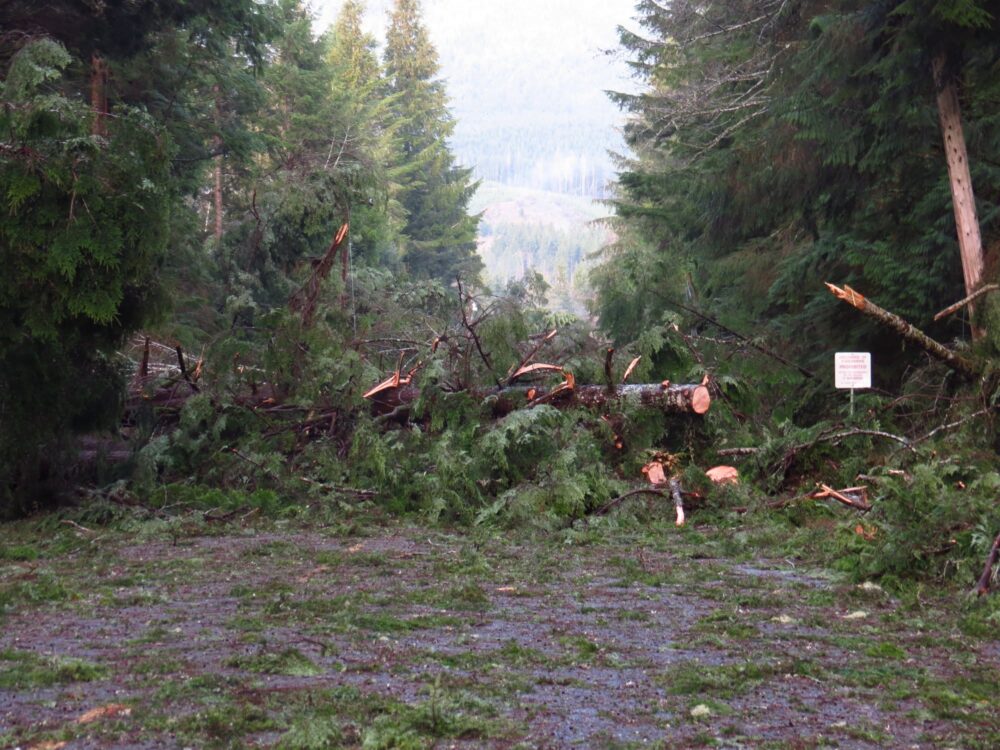
We turned onto Sayward Rd, but only made it about 100 meters before we ran into a huge pile of trees blocking the road. The trees were tangled up with wire power lines. We turned around and headed back to the intersection at the logging road. The logging road from here ran parallel to Sayward Road and allowed us to reach town. This road had been cut out as well. When we got to the house, the kids told us that it was terrifying during the storm; they thought the roof would be torn off and that it sounded like a freight train was running through the house. It had felt like the windows would blow in, so they hunkered down in the basement to ride it out. The power was out, but the wind had eased off quite a bit. The kids had the storm lanterns going; I set up our camping stove, cooked up a stir-fry, and made some coffee. After we ate, we all headed off to bed early.
I got up just before daylight and headed off to get some photos. The damage that was done was incredible. Sayward Road looked like a right-of-way that had just been felled, and trees were piled up 3 to 4 meters high and in groups of up to 30 trees per pile. There were many trees on homes and outbuildings, but the damage to these properties was minimal considering the number of trees that had fallen. There were many poles, transformers and wires on the ground. After checking out all the damage, I realized that power would not be restored anytime soon. So off to town we went to buy a generator so that we would not lose our food in the freezer and fridge. Power was not restored for 4 days.
The village of Sayward was on top of things during this time; they opened the community centre for longer hours. The centre had auxiliary power. Free showers and the use of the kitchen facilities were open to all who needed to wash or cook food. There were free snacks and coffee as well. This was the most damaging storm in BC Hydro’s history. It hit the whole island.
Guiding Eco Tourists
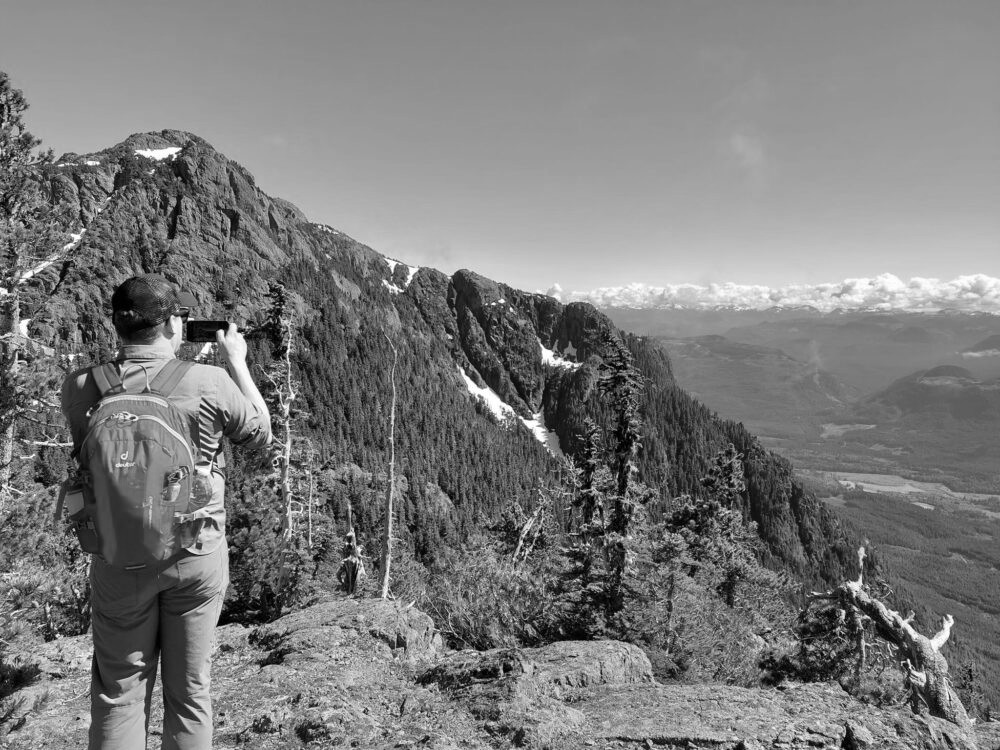
After the creation of gohiking, I began to get requests for a variety of outdoor adventures. Most requests were still for photography trips, but others wanted to see waterfalls or hike a mountain trail. Still others wanted to experience hidden caves or visit various communities on the island, historical places like Winter Harbour, Zeballos or Bamfield. One time, a family of six who hailed from France hired me to show them the North Island. The dad had a limited ability to communicate in broken English, and mom and the kids could not speak English. It is amazing how you can find other ways to communicate. The kids used smiles, hand gestures, and sound effects other than language to speak with me. The mom simply used smiles. We spent the whole day together and covered a lot of ground. At the end of the day, I got big hugs from all of them. Maybe they couldn’t say thank you in words, but the hugs told me how much fun they had.
My favourite guiding jobs are those that involve hiking in the high country. I love to hike. We are so lucky to live in an area where hiking trails cross the island; some are easy, while others are extreme trails, so you can have your pick. I have spent my life not just hiking the trails, but also playing an active role in trail building. I was part of quite a few trail creations and loved every minute of it.

During my time with the Forest Service, I was asked to be part of a crew of 10. Our mission was to construct the trails between the lakes that were going to be part of the Sayward Forest Canoe Route. This was an epic endeavour. We worked out of canoes. We started on one end of the proposed route and would canoe to the end of a lake; then we would follow a suggested route that was laid out with ribbons and put in a trail wide enough to move a canoe along. With 10 guys building the trail, we would move along pretty fast. With that said, it took us 3 months to complete the trails, as we had multiple bridges that had to be put in, rest areas and easy launch areas at each portage.
The trails on the island have always drawn me in and allowed me to see the backcountry. Some are just awesome and easy, like the trail between Botany Bay and Botanical Beach. This is an incredible walk through a forest of windswept and twisted trees. It’s a beautiful place, a place of wonder. For 7 years, researchers and students journeyed here to study at the seaside Marine Station. To get here, they would travel from Victoria to Port Renfrew by steamer, then traverse some very steep, muddy, and narrow trails to the station. There was talk about building a better road to the bay, but it never got built. This all but sealed the fate of the station; it was closed in 1907.
When you are hiking in the area, if you look closely, you can still see remnants of the buildings sticking out of the West Coast rainforest. There is a lot of history here, but you need to look closely, as the West Coast rainforest is claiming the land back once more. The area became a provincial park in 1989.

The beaches at both Botany Bay and Botanical Beach are full of a wide variety of sea life. Both plant and animal life are in abundance, and each has adapted to contend with the variable conditions found here. Black bears and cougars can also be present at any time. Black bears can become used to feeding on garbage, so to avoid teaching bears about trash, please pack out what you pack in. Cougars normally avoid people and are rarely seen, but please leave pets at home if possible and watch over young children.
British Columbia’s toughest and most beautiful trail was at one time the West Coast Trail, situated in the Pacific Rim National Park Reserve on the west coast of the island. Considered by some to be the toughest trail in North America, the trail traverses 75 km of wind-worn and storm-tossed coastal shoreline. You will see giant cedars, huge hemlock and unending spruce forests, cliffs, beaches, sandstone ledges, and suspension bridges spanning rivers and streams. This is Vancouver Island wilderness, wild and wet even in the summer. Hikers who attempt this trail must be fit and well-equipped for the backcountry. There is a new trail that follows the island’s center from Victoria to the tip of the island. It takes an average of 3 months to traverse, and it is now, by far, the most beautiful trail in the world. It runs along the spine of the island, which was its first name, but that was changed from the Spine Trail to the Vancouver Island Trail early in its creation.
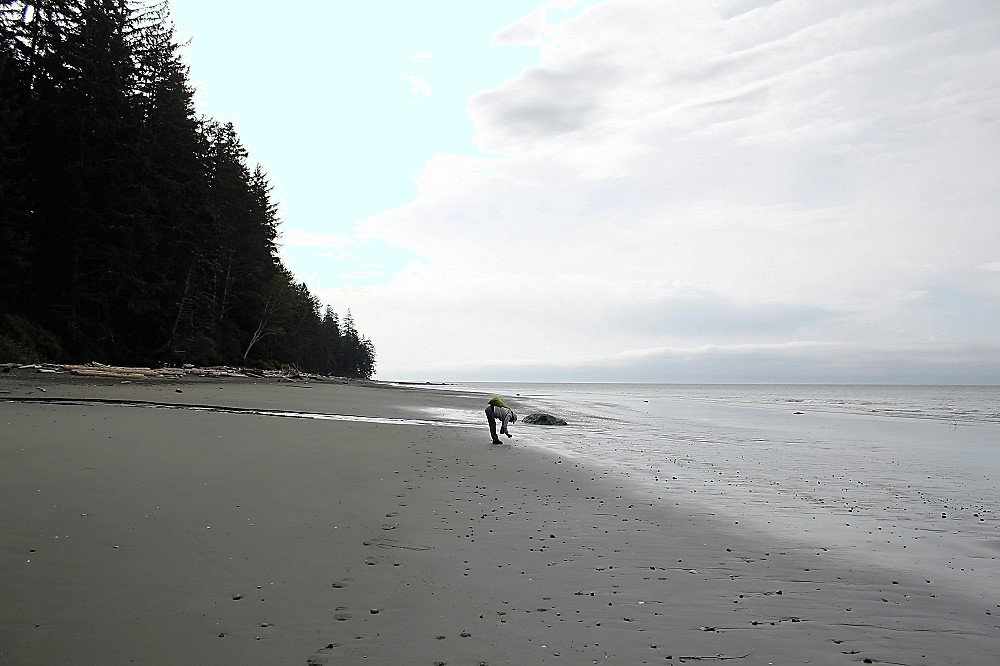
Then there is the 47 km Marine Trail in Juan de Fuca Provincial Park, which boasts scenery similar to the West Coast Trail, but with vehicle-accessible points at several spots along the trail, making it a favourite for beginners and day hikers. The trail begins at China Beach and ends at Botanical Beach. It’s a pretty awesome hike. China Beach is a very beautiful beach, a great place to go for a weekend walk. China Beach also has a great campground that is located in the west coast rainforests that grow so lush on our coast. The trail down to the beach is quite pleasant with some incredible views, not too difficult to walk, and the beach at the end is awe-inspiring, to say the least. There are 78 drive-in campsites available at this campground.

Some facilities are wheelchair accessible; pit toilets and water taps are located throughout the campground. China Beach itself is a great place to picnic and beachcombing. Remember that black bears and cougars may be present. It would be a good idea to leave pets at home and keep your children in your sight. Lately, we have seen some wolves showing up along the trails of the West Coast, farther north of here. You should keep pets on a leash at all times. Take a walk to the western end of the beach during the wet season, and you will see a waterfall that will take your breath away. You can walk along the shore to the second beach, or if you are camping, you can reach it by taking a wonderful trail through the forest to reach it. The waterfall is pretty awesome during the wet season.
In the spring and fall, you might get to see a grey whale as they migrate along the West Coast, or Humpback Whales in the inner waters. So keep your eyes open and your camera ready. The best times to see grey whales are March and April, as they migrate past the island on their way north to the feeding grounds. And humpbacks can be seen all year.

There are many other mountain trails on the coast, and some very historical trails like the Woss Grease Trail. This trail runs from Woss Lake to Tahsis, and it is a very old trail. You can also hike many trails in Strathcona Park. So put on your boots, grab your pack and camera and head out into the backcountry to see what the Island has to offer. Another trail that has mostly been completed is the Vancouver Island Trail, which runs from Victoria to the top of the island.
The Strandby Adventure
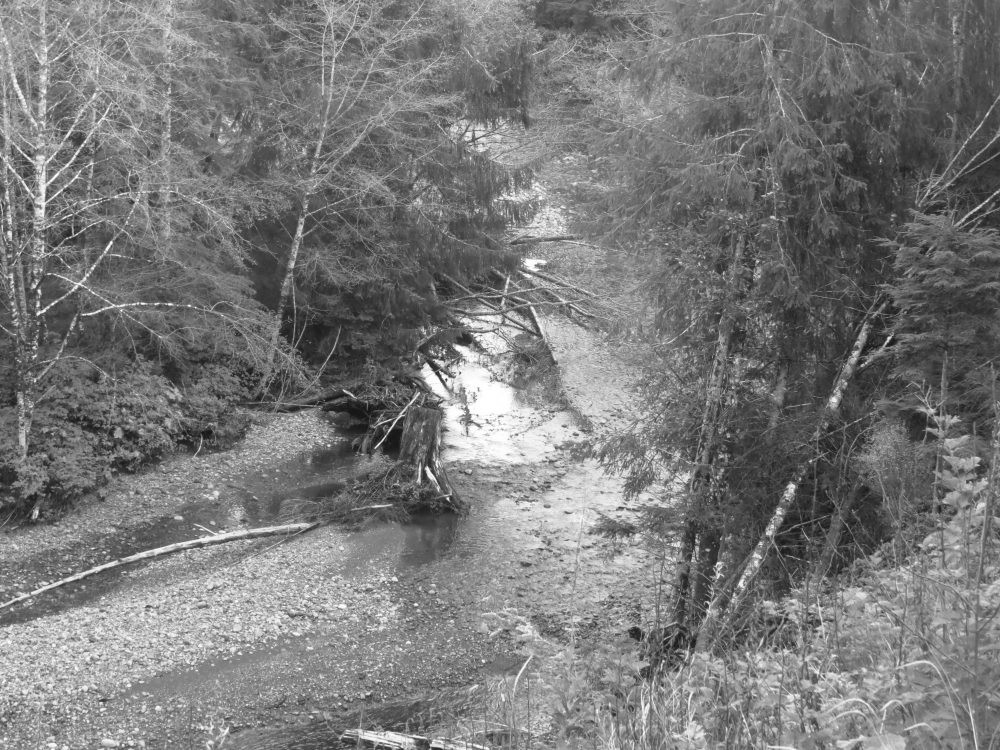
I was offered a contract to lay out the route for a trail north of Holberg, up on the Strandby Main. The job was to lay out a trail from the client’s property over to an unnamed lake. This lake is one of the northernmost lakes on the island and is several km from his property. We were to be paid 1500.00 per day plus expenses. My son agreed to join me in this adventure. We did not know just how long this would take, so we packed food and camping gear, and at 6 am Saturday, we pulled out of Sayward and were on our way. We made it to the Eve River, where the alternator blew. My son had a battery charger with a vehicle charger, and we used that to put a charge in the battery. We had to do this several times, as we could make about 10 clicks per charge. Eventually, a truck stopped, and we hooked up my jumper cables and put in a 20-minute charge. This gave us enough power to get home. We transferred all our gear into another vehicle and decided to head out early on Sunday.

6 am, we were off again; the trip to the strandby was uneventful, and we arrived around 11 am. The Strandby River flows into Shuttleworth Bight. From where we stopped the auto, we could see the windmills that are located on Nob Hill, just across the Strandby River valley. We were quite a bit further north than where these windmills were located. We put on our cork boots and rain gear and headed into the bush. The going was OK at first, and we made great time. We had GPS, and it was pretty easy to lay out the route. Eventually, the going got pretty rough: lots of logs down across our route, thick underbrush and creeks to cross, but we finally made it out to the lake.

We found an old homestead here and decided it was a great spot to end the trail. My son was checking out the old cabin and the area around it while I headed down to the lake to see where the client could put a dock in. It was pretty wet with high water. At one point, I got my boot stuck, almost getting a soaker, so I went to take a step back with my unstuck boot. Unknown to me, my other shoelace was untied, with one strand being under the stuck boot. So, as I leaned back to adjust my balance and pull my foot out, my foot would not go back, and as I was already leaning, there was nothing I could do but fall back; I did, and wound up swimming in the lake. I had my camera in my hand, and all I could do was hold it high as I went right under. So l there I was, swimming in the northernmost lake on the island, unintentionally. It was very cold.
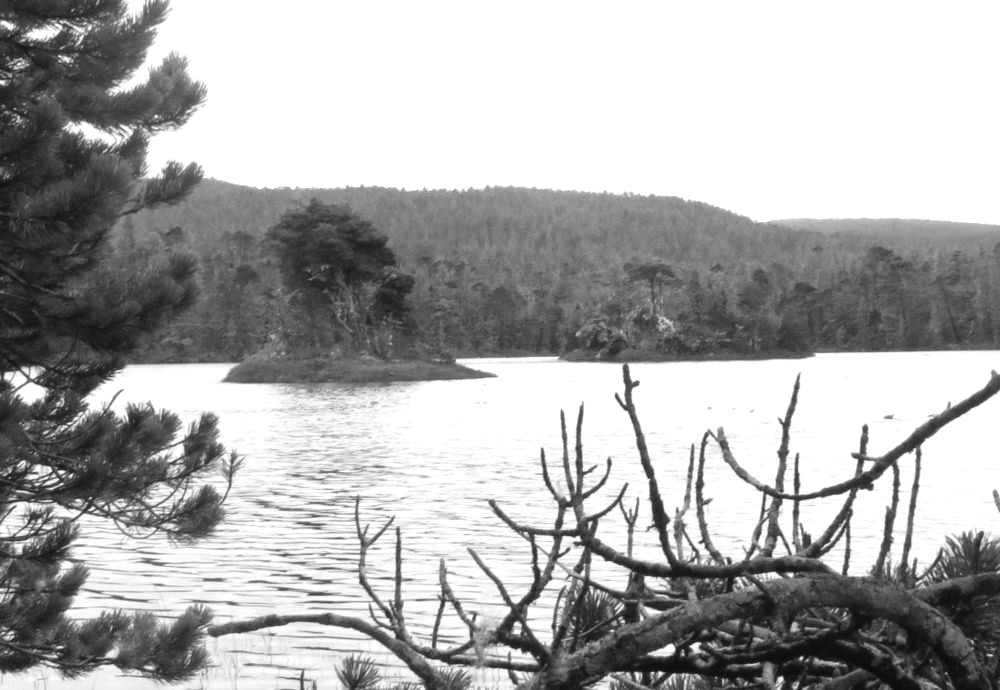
The way back to the truck was pretty tough. I wound up getting leg cramps in both upper legs, and it was quite the struggle. We reached the truck just at dusk. I changed, and we headed off, happy in the fact that it only took one day to complete the job. The road was good, and we expected to reach Holberg in about an hour.
But on the drive out, we hit a rock and tore a hole in the oil pan, which drained the engine in about 1 minute. I shut it off, and we took a look; there was no going on, so we took stock of our situation. We were completely immobilized with 26 km of old road where we were unlikely to see another soul between us and Holberg. With my leg cramps, I knew it would be a tough walk, but we started to walk out. I made it about a km, and the leg cramps came back. I could not go further, so my boy Robert said to me, “Dad, you have to go back while I head out. I will find help and get back to you as soon as I can”.
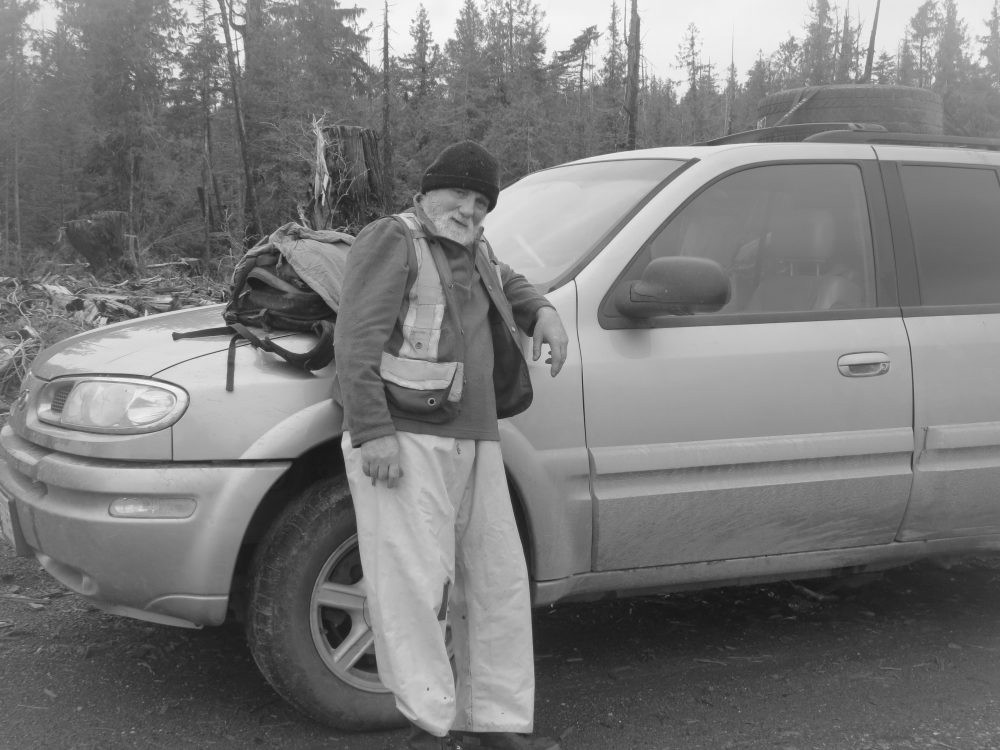
It was dark, and on the way in, we saw many bear scats. We both had headlamps, but I was quite worried about my son. I had to agree to let him go on alone, while I headed back to the SUV. I could not run the SUV, but I had a sleeping bag that I wrapped myself up in and got settled in for the night. I figured it would be some time the next day before help arrived.
I fell asleep after some time. Then around midnight, I heard a truck coming up the road. Sure enough, it was my boy with help; he had run into Ken and his incredible pup, Timber, who was his friend from Holberg. Rob had made great time walking out; he was just 6 km out of Holberg when he ran into Ken. After telling Ken about our situation, they returned to grab me. Ken took us to his house, fed us and provided rooms for us to get some sleep. he told us he would be heading out to work around 5 am, but that we could stay there using his phone and internet to find a ride out. I got online before sacking out and put out the request for a ride out.
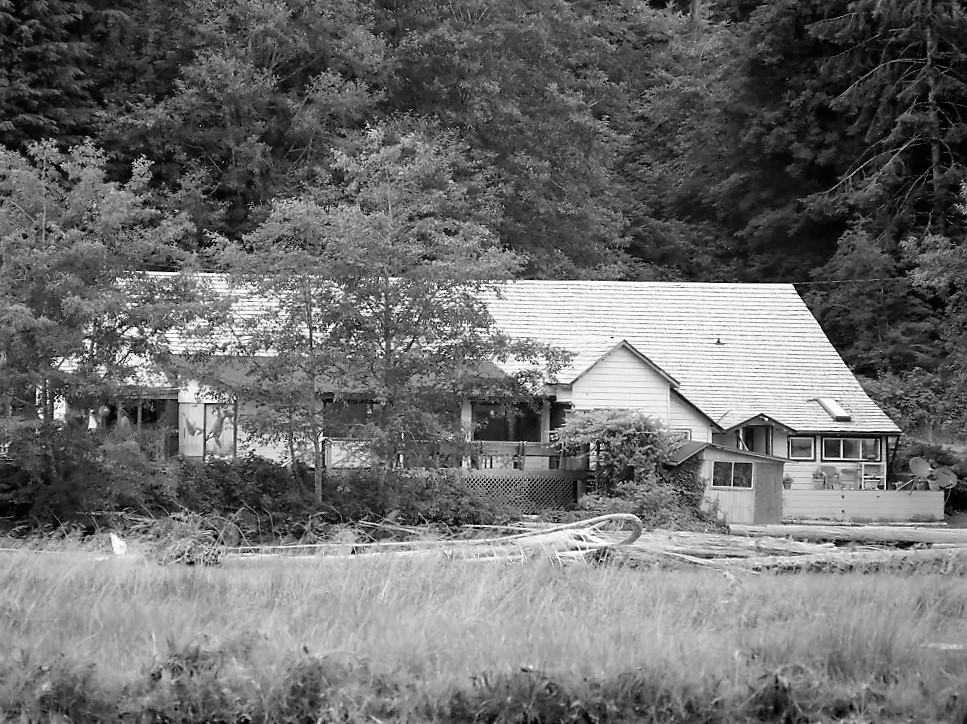
In the morning, I turned on Ken’s computer to begin searching for help, and there was a message from my good friend Donny, who is from Woss, asking me where in Holberg we were as he was ready to come to get us. Could not connect with him from Ken’s computer, so we decided to try and find a cell connection, but had to wander a bit around town to find one, and finally got one at the Ibis. Just as I was trying to call him, Donny pulled up smiling like a cat chewing bumblebees. It was good to see him.
Over the years, Donny has pulled us out of many bad situations and saved our asses almost every time we got into one. You could not ask for a better friend. He picked us up, and off to Sayward we headed. The trip was fine, and we got home quickly. I got on the horn and called another friend here who had a trailer I could borrow. I arranged to get it the next day, and he also lent me a set of racks to load the SUV on the trailer. Donny came early, and we went and got the trailer, and off we went back to Holberg and the SUV. On the way in, several of the deck boards broke and were gone when we got back. On a closer inspection, we realized all the deck boards were rotten, so we managed to locate some used plywood that we could place over the deck boards, making it strong enough to hold the SUV. We got up to the SUV mid-afternoon and pulled the trailer in place. I set up the racks and started the SUV, and quickly tried to pull it up onto the trailer, but both racks collapsed and were completely useless now. So here we were needing to remove both a trailer and an SUV from the strandby.
Donny says, Let’s tie the car to the trailer and pull it all out at once to Holberg. During this time, his rear brakes began making some pretty horrible sounds. We made it to about 5 km from Holberg and decided we would take one at a time from there. We took them to Ken’s house, but he was not home, so we dropped both off there and hoped he would be ok with that. We figured that with all the noise the brakes were making, we would leave both at Ken’s. We made it out, and I again got on the horn looking for a trailer and truck I could rent to get this SUV out. I was getting tired of this drive.
No luck finding any rentals for what I needed, and I even phoned all the North Island tow companies; only one would drive the Holberg Road, and he wanted 2200.00 for the tow. He did say that if we could get it out to the pavement, which was 61 km of rough logging road away, that he would tow it to Sayward for $500.00. So I called Donny with the news, and he said if I could do his brakes, we could tow the damn thing out with his truck. I agreed, and Donny’s wife headed into Campbell to pick up all the brake parts. He thought he might as well replace everything; it was a 1300 bill.
Patty picked me up on the way back home while he got the truck up on blocks and removed the rear wheels. I got to work as soon as I got there, starting with the callipers. As I removed them, I noticed that there was nothing wrong with them, but as I pulled off the rotors, all the emergency brake pads and hardware fell out in pieces- the same thing on both sides. It was the cause of the problem. We had no replacement parts for this, so I just removed everything from inside the drum. Don decided to have me replace the pads on the rear brakes, but we did not need to replace the callipers or rotors. The truck was good to go. Donny took back the unused parts, picked up the needed emergency brake parts and hardware later. Donny took me home and would pick me up in the morning for another go at getting the SUV and trailer out to the highway.
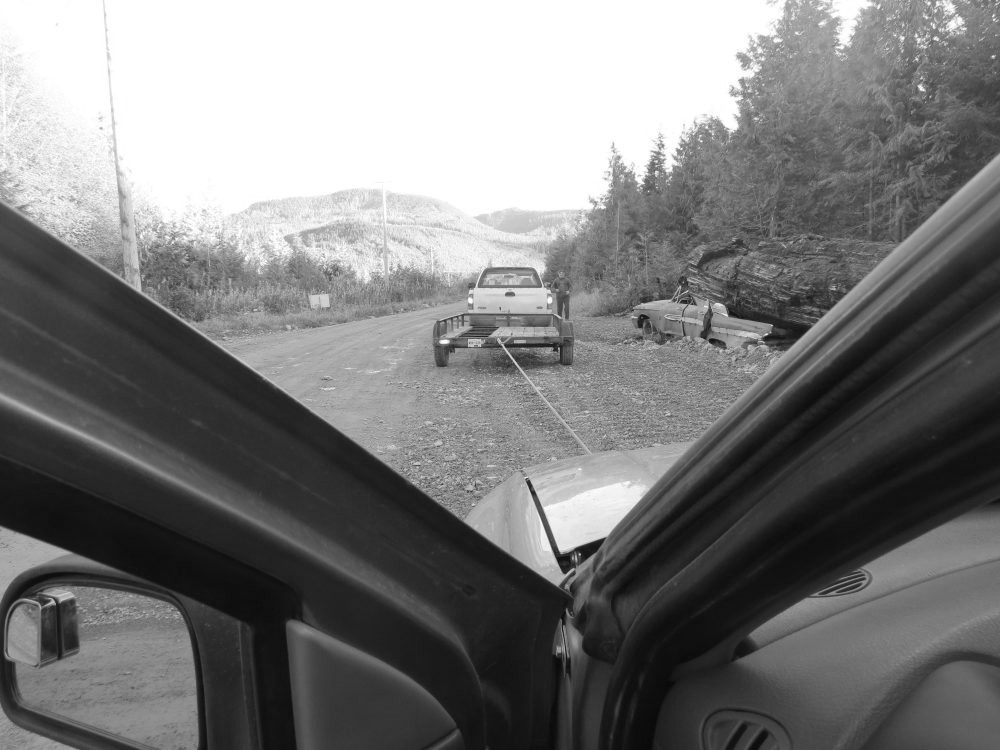
Donny picked me up at around 10 am, and off we went again, determined that we would get it done today. We made good time getting to Holberg, and once we were there, we hooked up the trailer and then backed up to the SUV. I tied a big rope between both, and off we went.
Donny is pulling the trailer with the SUV tied to the trailer about 50 feet behind. It was a slow haul out of the 61 km, but the rope only broke once, and in about an hour and a half, we were at the highway. I phoned the tow guy who arrived about 30 minutes later; we loaded the SUV, and off he went, the driver being 500 dollars richer. 2 hours later, all was well at home, and the adventure was over, except I now needed to put an alternator into the van so we could be mobile again and replace the oil pan in the SUV.
Caving

One of the things my boys and I enjoy is caving. I have friends who ask me why, after all the wonders to see in our world, why would anyone want to venture underground through hard, flat-out crawls, in tight holes and seemingly endless long drops through steep and fast-flowing waterfalls just to reach the bottom of some hole. I always struggled to find a way to answer this in a style that could help them understand just what it is that draws us underground, and I usually fail.
I dropped into my first hole when I was about 7 years old, and I have never looked back. That was many years ago. My boys, Robert and Forrest, both have gotten the bug, and they love getting underground.
We are not just cavers, though; we love searching out new caves, and we have found quite a few of them. Cave hunting is my thrill now, as after many injuries and a screwed-up knee, I now find that exploring the holes is something I struggle with; walk-in caves are cool, though, and I love getting in to explore them. For the past couple of years, we have been hunting caves up in the Adams River area. In past years, we have explored areas around Tahsis and Holberg and other areas on the South Island.

We spent time exploring the area around the Minigil Cave, crawling about in caves like the peat cave, the deer cave or the raging river cave. There must be many more in this area. Of course, we always love getting out searching for caves up on the Memekay River, where I dropped into my first hole. Every time we go out, we find one or more caves, or we can at least conclude an area to be cave-free, although there was a time I walked by a cave many times before seeing it. This was the fishy-hole cave up on the Memekay River, so one should never call an area cave-free.

We love to go caving, but there are a few things you need to know before entering any cave system. Are there any drop-offs in this system? Are there fast-flowing underground rivers that can be a hazard? There is more than one route to follow; there is nothing worse than getting lost in a multi-cave system.
When you are going into a system, always carry a map of the cave system (if possible), carry several sources of light, like a headlamp and a handheld flashlight, and always carry several long-burning candles for an emergency, like a flashlight or headlamp failure. A helmet can save you from some nasty bumps to the head, and always bring extra warm clothing as cave temperatures change little through the seasons.
The Upanna cave system is located about 17 km west of Gold River, on Head Bay Forest Rd, on Vancouver Island. These caves are just awesome to hike in, and you can find everything here in formations and cave life; lots of crickets and spiders to photograph here. This system is perfect for new cavers.
There are many caves in the Paterson Lake area; one of which I have still not found is so large that it takes 2 days to travel through, requiring a night spent underground, or so I have been told. The Holberg area has a few very big and deep caves, but be careful here, as there is a chance of running into underground rivers. The Zeballos area also has some very beautiful caves, some of which are protected, and you need to have a guide to enter. Then there is the Horn Lake cave system, one of our more famous karst systems. These caves are incredible.

For an even deeper adventure, join a guided tour of the white ridge caves. The White Ridge Provincial Park is located at the boundary of Strathcona Provincial Park’s northwest corner on the Gold River Highway. The park is located 4 km west of Gold River and is accessed off Gold River Highway on the BR 80 logging road.
The Huson Cave system is a great place to introduce the public to caves carved out of limestone rock by Atluck Creek. The system contains 15 caves that are easy and safe, perfect for the inexperienced caver; no special equipment is necessary. The Little Huson Lake Cave Park is in an incredible area of the island, and the canyon has some very special features which are unique to Vancouver Island.
The Cave Park includes the Atluck Creek Canyon. This canyon has some interesting, beautiful features. There is a wonderful natural bridge that is quite amazing, and a large cave entrance where the creek flows underground for 60 meters; this is known as the Cathedral Cave entrance. The bridge feature is the only one on Vancouver Island.
The park has some other minor karst features like scallops that form in the rock walls; they are rippled rock surfaces that have been created by high-pressure water flow.
There are ample areas to camp in the area, with the Huson Lake site being the closest. This is a very nice campground with lots of space. There is a boat ramp and picnic tables, along with a very large green area.

The beautiful Eternal Fountain waterfall is a spot that all should visit. This waterfall is truly amazing and a wonder to see; it flows out of the rock face, drops for about 5 meters, and then disappears back into the mountain. If the beauty of these falls is not enough for you, you can drop down to the base of the falls and go behind to discover the backside of this underground waterfall. There is a beautiful subterranean passage that has been sculpted out of red rock, which has been carved out by the passing of the underground river.
The tunnel behind the falls meanders along as it follows the roaring stream on its route through the cave to the end, where it drops into a deep sump and disappears. An awesome sight to see, but please be careful as the rock passage can be very slippery.
Along the route, you will also have the opportunity to visit some other incredible spots like the Devil’s Bath, Canada’s only cenote. A cenote is a sinkhole surrounded by rock bluffs and is filled with groundwater. The Devil’s Bath is connected to the Benson River Cave system via an underwater cave. Devil’s Bath is located in the Quatsino limestone karst system, which contains many karst formations and cave systems.

You can also visit the Disappearing River and the Reappearing River, a part of the Benson River that flows underground for about 2 km before reappearing again. The trail into this site is not marked; there has been a washout on the trail route, and it’s suggested that you pass this spot by. But if you are adventurous, you can locate the trail and hike in on a short trail that takes you to an incredible place; you will see a river roaring down a canyon and then dropping into a deep hole and disappearing into the mountain, only to reappear some 2 km away. Quite a sight to see.
To get to the Eternal Fountain along with the Devil’s Bath and the Disappearing River, turn off onto Keogh Rd just north of Port McNeil and head south; drive a short distance, and you will see a sizeable directional sign with a map of the Alice Lake Loop. This is where you choose your route. The drive is about 100 km, with a driving time of 2 to 3 hours, but you will want to have the whole day, so you can explore these wonders completely.
On your drive, you will have a good chance of seeing black bears, elk, cougars, deer, wolves, and any number of smaller forest creatures, and if that is not enough, the birdlife here is just incredible. The numerous lakes you will pass have exceptional fishing along with great camping areas, so you could take your time and stay overnight in one or more campgrounds and spend several days here. This would allow you to get to see the North Island and all it has to offer. Be careful, though; caving can become an obsession.
Kayaking
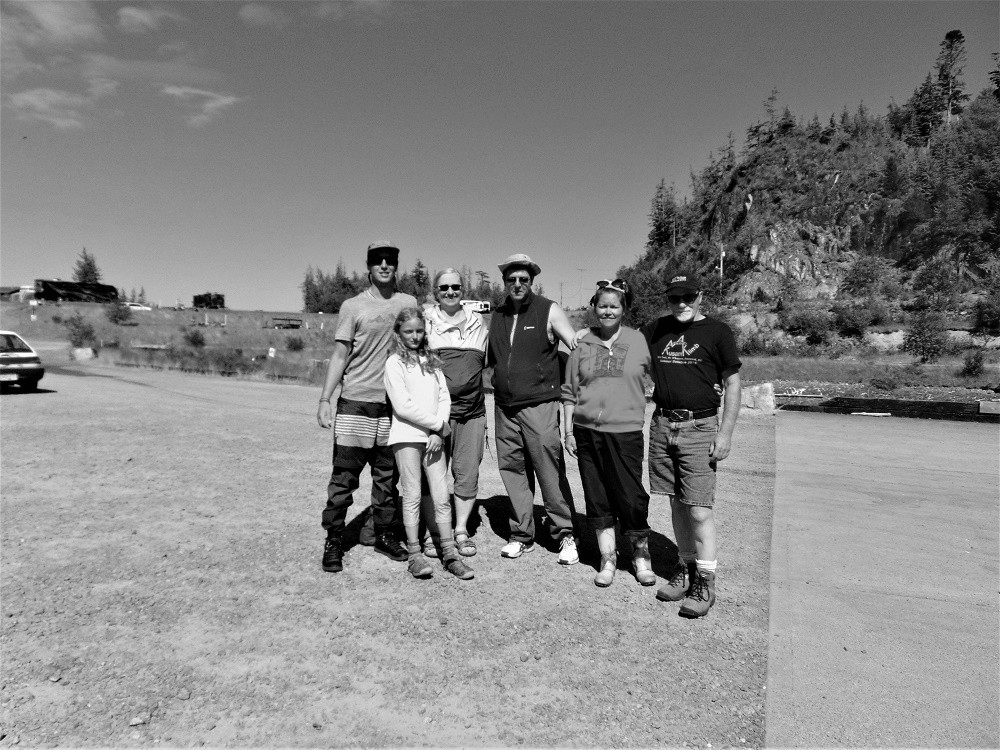
In the fall of 2015, we were offered a kayaking adventure by a good friend of mine who owned North Island Kayaks. On the day of the trip, at 4:30 am, Georgina and I were on our way to Telegraph Cove to head out on the kayaking adventure. This was a chance to go out for three days, with a guide who included all the kayaking equipment, camping gear, and food. It was going to be pretty awesome, and we both were very excited. Upon arrival at Telegraph Cove, we met the other members of our trip. Chet Morrison and his daughter, Alexandra, are from Pennsylvania.
Barbara is from Oregon, and our guide, Danial Finer, hails from Salt Spring Island. After introductions, we loaded our kayaks, with my wife and me in a double kayak. Chet, his daughter and Barbara were also in a double, but the center cargo hold had been refitted with a seat for Alexandra. Danial was in a single. After pulling out of the cove, we headed across Broughton Strait and into the Cormorant Channel Marine Provincial Park. This park is located at the western end of Hanson Island. During the crossing, we saw many Dall’s Porpoises; they are such beautiful animals.
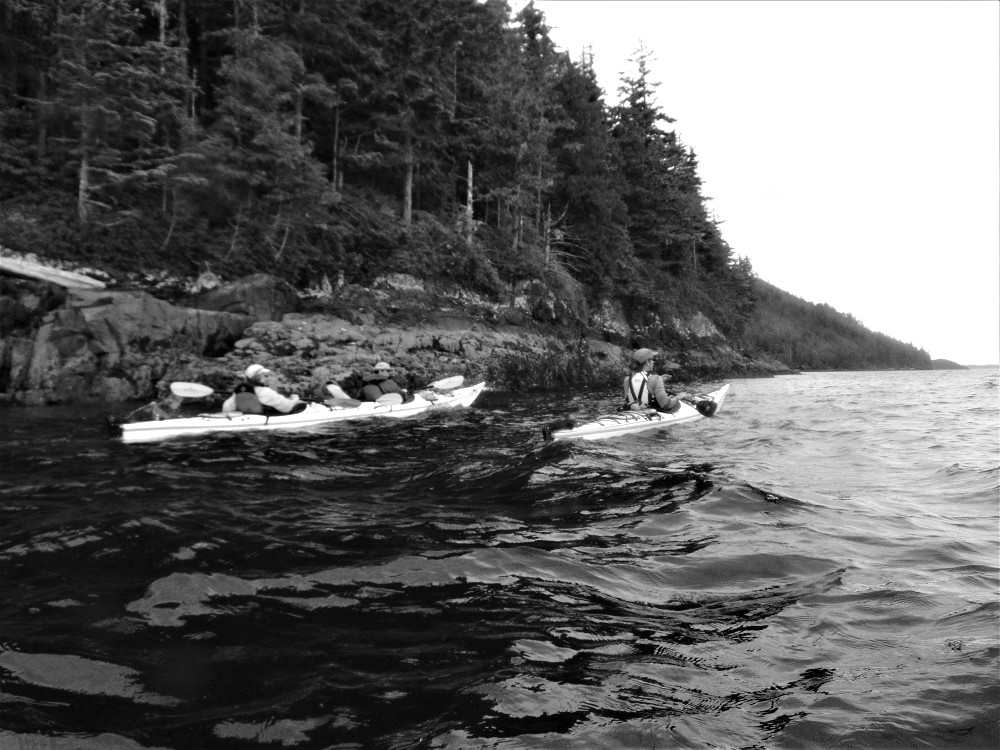
I have some kayak experience, but the other guests were fairly green. As we went through the channel between the Plumper Island Group and Hanson Island, we hit a very strong current that we had to push against; it was quite a struggle for my wife and me. It was a great way for the others to learn how to control their craft. It was tough, but all of us got through. We then headed into a small cove on the north side of the island, where we stopped for a wonderful lunch that was put together by our guide, Danial, while the rest of the team rested up.
The rest of the day, we travelled down Blackfish Sound along the north shore of Hanson Island. We saw several whales off in the distance, but they were too far away from us. We did get to see deer, mink, seals, sea lions, and a few more porpoises as we headed to the east end of the island. We went between Hanson and Little Hanson Islands on the eastern end and arrived at our first camp, where we would spend the night. The company has 6 of these camps located in various places in the area, and they are incredible. There are 6 or more tents set up on platforms, covered cooking and eating areas, compost toilets and vistas that will take your breath away.
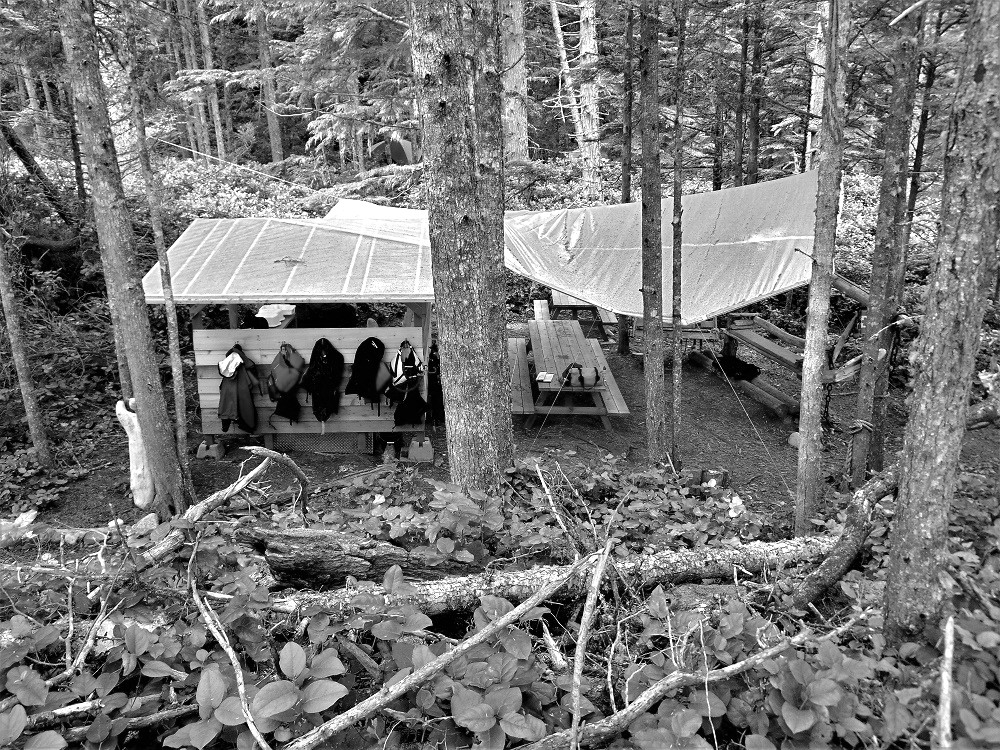
The guides do all the cooking and cleanups. Our dinner on the first night was awesome, and Danial created barbecued salmon, rice, salad, and various treats. We all ate heartily after that first day of kayaking. These guides are pretty incredible, and I have to hand it to Danial, who looked after us very well. After dinner, Danial got the kitchen area cleaned up and then started a fire where we all sat around eating s’mores and getting to know one another better. We could not have asked for a better group of folks to spend three days with. We all got along quite well. Georgina and I headed to bed around 9 pm and fell asleep pretty quickly.
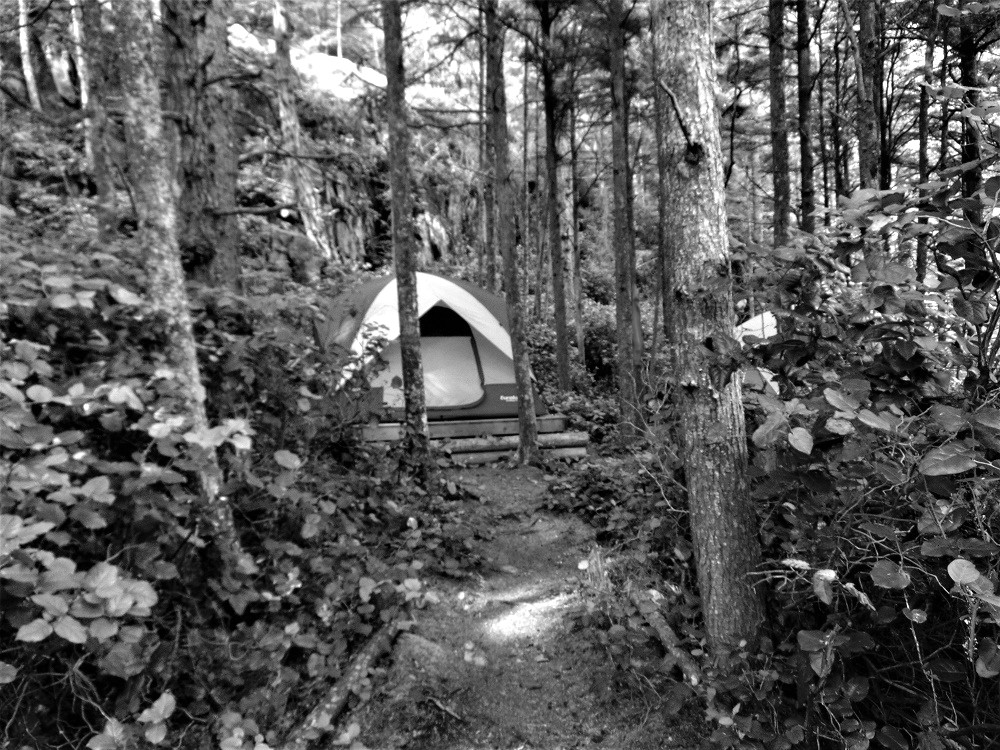
At 3:30 am, she woke me up to say that she thought she could hear whales just outside of camp, but that she was too scared to head out to see. I told her it was most likely just waves from a passing boat and then rolled over to get a few more hours of rest, but just then, I heard the unmistakable sound of a whale breaching. It is amazing just how fast we got dressed and out onto the rock bluff overlooking the strait. As we trained our eyes to the early morning light, there they were, a family of Humpback Whales feeding off in the distance. It was an awesome sight. They entertained us for more than an hour; it was incredible. This is what we had come to see. The sound of them breaching was like thunder. There was no going back to bed after this. I sure do wish the others had been up to see these whales.
After the rest of our group woke up and we all ate a wonderful breakfast of banana pancakes and sausages, we carried the kayaks down to the water. After getting them loaded, we headed out for our second day. We headed across the entrance to Black Fish Sound, between Hanson Island and West Cracroft Island. Then, we travelled along the southwest shore of the island until we reached the Sophia Islands, stopping for a short break along the way. This was turning out to be a trip of a lifetime; everyone in our group was having such a grand time. Chet informed me that he had just returned from a 2-year stint as a trauma surgeon in Afghanistan and needed this adventure.
We saw lots of Dall’s porpoises but no whales, and after passing the Sophia Islands, we headed across the Johnstone Strait to the western boundary of Robson Bight. We stopped for lunch here.
After lunch, we headed west up along the shore of Vancouver Island until we reached the camp for our second night. This was just west of Kaikash Creek. As we finished carrying the kayaks up to the high tide line, we spotted a humpback whale just offshore. It was swimming slowly just on the outside of the kelp bed, and all of us were able to observe it well. I am pleased that the others were able to see it.
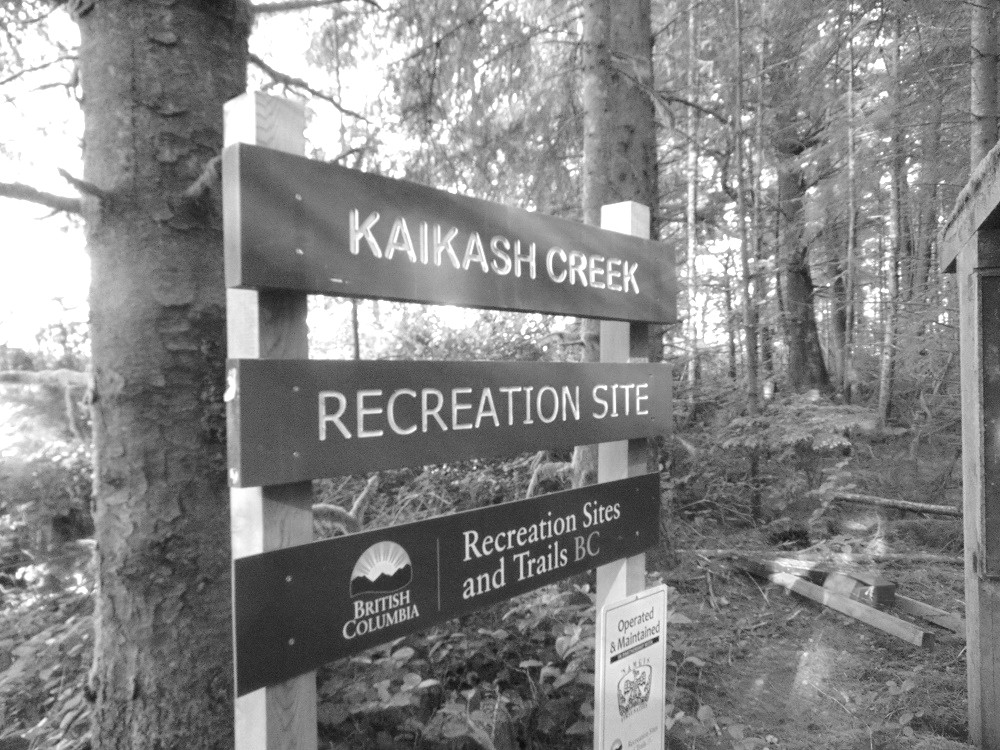
After a great dinner of homemade chilli and buns, Georgina and I headed down to see Kaikash Creek. It was nice to stretch our legs a bit. There is a public campsite here that is maintained by the Namgis People, which is only accessible by water. Nice site with plenty of tables and a double compost toilet. The creek is very pretty, and the water is fresh.
That night was an early night for us, as Gina and I had gotten up at 3:30 am. We slept very well and woke up to the smell of fresh coffee, eggs, and bacon cooking, and Danial was in the kitchen with a big smile for all of us. Danial was always smiling. He also had a great knowledge of the area and could answer all our questions in a way that we could understand.
After packing our gear and loading the kayaks, we headed west along the shore of Broughton Strait towards our final destination of Telegraph Cove. There was some wind, and we had waves rolling over our kayak; this was quite exciting to Georgina. We made a lunch stop at the Blinkhorn Rec Site, where we had pita bread sandwiches filled with tuna salad and other treats. We then hiked out the trail to the Blinkhorn Light, where we had a great view of the strait. There were a few seals and sea lions.
The Blinkhorn Trail is a beautiful, well-marked trail that wanders through rainforests overlooking Telegraph Cove. There are huge old trees and giant rock bluffs along the way. We always see amazing sights along this trail. Sometimes it’s whales in the ocean or black bears on the trail. Other times it’s some sort of mushroom or plant; you just never know what you might see, so keep your eyes open. For part of the way, you walk the old telegraph trail, and then in other areas, you follow natural animal trails. The telegraph trail was put in 1912 when the line was extended to the area, and the cove became known as Telegraph Cove.
Once back at the Blinkhorn Rec site, we had a bit of rest, and then Gina and I explored the rec site. This site can be reached on foot from Telegraph Cove, and the trail is part of the one we used to reach the bluffs where the light is located.
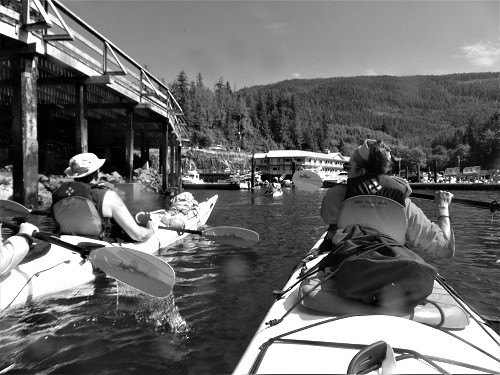
After a bit of rest, we headed back to the rec site, loaded our kayaks, and headed out on our final leg of the journey back to Telegraph Cove and reached the end of our trip, all too soon for all of us. It was a trip of a lifetime. Gina and I had such a great time. My friend sold his kayak business the next year.
The Compass Magazine
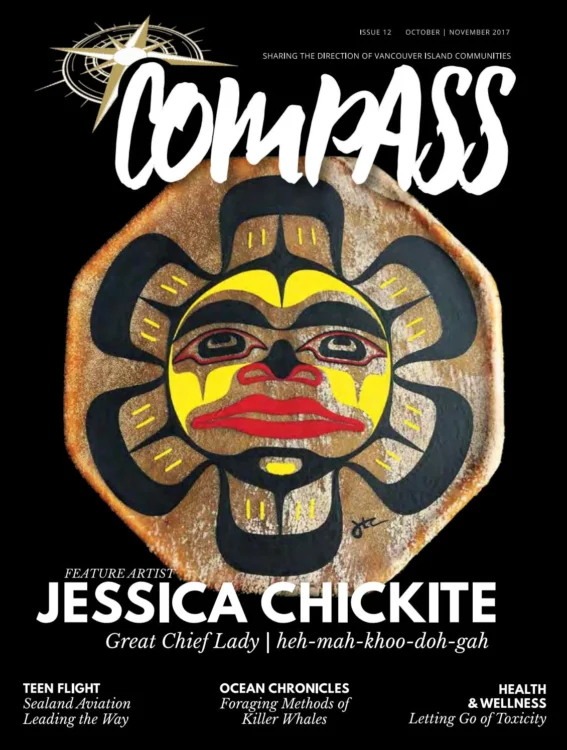
After the kayaking trip, an associate of mine, who was starting a new magazine, which was going to be an Aboriginal-based magazine. It was called the Compass. She called me out of the blue to ask if I was willing to write a story for the inaugural edition. I thought to myself, why not? So I agreed and then asked her what the deadline was, and she replied that it was tomorrow. I told her she should have called me sooner, but I wrote it that night and got it off to her the next day. She then asked if I would write for the mag, and she would give me a column and let me name it. I agreed, and the column, Off The Beaten Path, was created. Little did I know that this was the start of a multi-year adventure in writing/publishing.
At first, Kealy had an editor working for her who would edit our stories. This was fine until he would take it upon himself to rewrite my stories. When I would see them in the mag, they were sometimes completely different, and this was quite disappointing. I made a condition of my continued work that my stories could only be edited for grammar and spelling, and the story must stay in my own words. They agreed, and I stayed on. Over the first year, a few of the other writers left, and after each, Kealy would ask me to pick up their columns. Soon, I was writing 8 columns.
Then our distributor quit. I took over distribution and helped in a limited way with sales of advertising space. At this time, we were covering from the North Island down to Courtenay. I would personally deliver the mags to all the hotels and motels, gas stations, restaurants, lodges, and anywhere else I could get them into. I extended our coverage as far as Parksville in the south and Port Alberni to the west. I made many friends along the way. I am a people person and enjoyed chatting with everyone. They always had a smile for me as I made deliveries. Smiles are much appreciated and would make me feel welcome.
A few years in, I started to see a pamphlet detailing North Island Trails. I thought it was a great little booklet; it was called Off The Beaten Path, just like my first column. Then they wrote my publisher, demanding that the magazine stop using the name of my column. According to them, they had originally published the guide way back in 2016 and claimed it as theirs. After I told them we’d used the name in every issue since 2015 and produced a copy of the first magazine in 2015 with the column in it, we never heard from them again.
Kealy, at the time, was also working for the North Island Metis and would always ask me to work with them. One of my favourite things was working with children. They would set up a huge tipi where I would sit and tell stories to classrooms of kids. I enjoyed this, and watching children laugh at my stories was awesome.
She would also hire me to do various types of forest walks with both the elders and the youth. I would teach about the ecology of the forest and how it all works together. I would sometimes take groups out who wanted to learn about plants and mushrooms, or perhaps about natural medicines. My wife, Georgina, always joined me, and she would help the elders navigate the trails and share her knowledge as well. It was always a fun time; sometimes the groups would get pretty big. My wife was also the photographer for these outings.
Around this time, Kealy took on the job of creating a First Nations-based radio station and asked me if I would consider taking on the publisher’s position for the magazine as an interim publisher. I took on the role, and over the next year or so, I learned a lot about the publishing world. I was flying by the seat of my pants, but all in all, things went well. It was quite the adventure. Hard to believe it had been 5 years since I started working for the Compass.
Diabetes Strikes Me Down
In 2020, I had begun to suffer from hearing loss along with an unquenchable thirst in a big way and found I had to relieve myself quite often. I went in to see my doctor about setting up a hearing test. As I was leaving his office, I remembered to mention my thirst and the need to constantly urinate. He told me to sit back down and called a nurse in to give me a blood sugar test. After testing, she showed my doctor the results, but in a way I could not see. He then told me that he wanted me to leave his office and go across the street to the hospital emergency ward, where they would take me up to the ICU. I asked him what was going on. He said I was so close to being dead that he was surprised I was still standing; my blood sugar levels were among the highest he had seen in one of his patients.
Our Hospital was brand new with a very modern ICU. The whole unit was round with a large desk in the middle; the rooms were all along the outer wall, and there was 1 patient per room with a window that those in the center could watch. In front of the window was a small desk and seating for a nurse; each room had a dedicated nurse who looked after you for her whole shift. These nurses were just incredible. Over my stay there, I had become attached to these young ladies. As it was COVID time, I could not have any visitors. My wife was allowed to visit, but as we lived in a community 50 km away and she did not drive, she was only able to visit on two occasions. Without the nurses, I might have gone mad. I can still see the smiles that they greeted me with every time they entered my room. I can’t say enough about how awesome these young ladies were.
After 13 days, the doctor informed me that I was going to be released the next day. I asked all the nurses to come into my room. When they were all there, I told them that if they were my daughters, I would be so very proud of them all, as their fathers must be. It was quite emotional, with tears shed by all of us. We had become quite close during my stay. After this experience with diabetes, I began to think of retiring. I informed Kealy that I would need to be replaced at the Compass. I had been part of this magazine for 5 years, but the time had come to slow down. I don’t think Kealy took this very well; she has not talked with me since then.
The New Knee
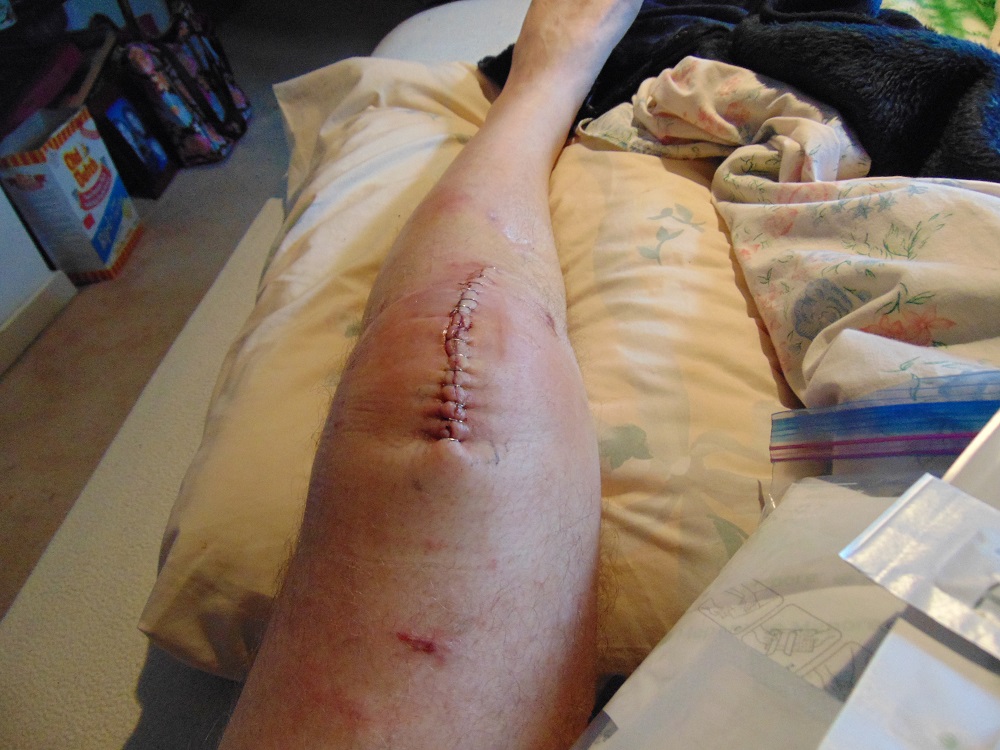
In the fall of 2020, during the COVID outbreak, I was called by the bone doctor who told me it was time; a new knee was finally in the works. After years of suffering with a bad knee, Dr. Botsford’s office finally called me to come in for a consultation about my knee. This was good, as my knee brace was no longer able to keep the pain away; it had worked well for years, but my knee was giving up the ghost. The doctor was surprised at just how bad my knee was. He was impressed that I was still out hiking. After looking at my X-rays and having a good look at the knee and leg, he told me this was going to be quite the job.
The leg was originally broken and repaired back in the early 70s. They did their best, and I was glad I still had my leg, but it had healed crooked, and the lower bones were joining my knee at an angle. This was why it was in such poor condition. Not only that, it was almost an inch shorter. The doctor said he would have a knee replacement designed that would straighten out the leg and increase my leg length to make it almost the same length as my other leg. He also warned me that I would most likely not be able to kneel on this knee again; he said caving was not going to be a thing I would be doing much of in the future. Normally, the wait for surgery could be up to 2 years. Botsford said he would fast-track me based on the condition of the knee, but warned it still could be a year. He asked if I would like to be on his cancellation list, warning me that I would need to be ready when and if they could fit me in early. I said that would be awesome.
After the doctor’s visit, I made the mistake of watching YouTube videos of total knee replacement disasters. My god, but this scared the shit out of me. One had a doctor standing on the table, big hammer in
hand, trying to free a drill bit from the guy’s leg bone. He was pounding with all his might, and the drill bit was stuck fast. If you are waiting for this operation, may I suggest that you do not view these videos?
Three months later, I got the call to be at the hospital the next morning. I was terrified, and it all was becoming very real. My knee was so bad that I put my fears aside and was at the hospital the next morning. They took me into pre-op, where they got me out of my clothes and shaved my knee area. After getting me on a gurney, they put in an IV and gave me a shot to relax. Then we began the trip into the operating room; my heart was racing, and I was really afraid, but the shot they had given me helped. Once I was on the operating table, I was given another shot that immediately sent me to la-la land. Now there was no backing out. I came to during the procedure, just for a second, and saw what was going on. In my fuzzy mind, I heard the nurse say, “he is waking up”, and then I was gone again. Was this a dream? I can’t say for sure.
Then I was in post-op, and although I could see my leg was pretty swollen and full of staples, there was no pain yet. I was kept there for about an hour, then was moved into a room. I was beginning to feel some discomfort. Later in the afternoon, I began to feel real pain; I mean, really bad pain. I got a shot, and it helped.
The next morning they wanted me out of bed and exercising. I tried, but my leg was damn sore, and I was getting dizzy spells. Dr. Botsford came to see me in the afternoon and told me I needed to start working on my knee and that not doing so was going to impede my ability to bend my knee. I was grumpy from the pain. The doctor and I had quite an argument. Words were said, and he was pissed off.
He was saying that I was going to be one of those people who wasted his time. I told him that, contrary to his beliefs, he was not a god, but just a mechanic. He said if I did not start physio right away, my knee would seize up. When I told him that, as I lived in Sayward, trips into the CR hospital were out of the question, so I would be looking after my physio myself. He stormed out of my room madder than hell. With me yelling words that should not be in this story.
I signed myself out of the hospital the next day, and with much pain, I drove myself home. I spent the next week in bed but also began to bend my knee. As soon as the swelling came down enough to do more. I started to do deep knee bends on the stairs and other forms of bending. I would get on my knees and force myself to sit back on my haunches. I took no pain meds so I would know if I pushed too hard. Within a few weeks, the swelling came down and the wounds healed. I went into our local clinic and had them remove the staples. I then started the next part of my self-designed physio.
I was the cook in our house, and everyone was waiting for me to get back at it, but now, when working in the kitchen, I would move about on my knees. At first, this was pretty painful, but the more I did, the less it hurt. This exercise had two effects: it helped me increase my ability to bend my knee, and it worked to reduce pain from kneeling. Eventually, I was able to kneel with hardly any pain and almost sit back on my heels. This was important, as I love caving, and caving involves being on your knees a lot.
Then I was called in to see the doctor. I could tell as I walked into his office that he figured he would see me
in bad shape, and he asked how things were. I immediately got down on my knees, sat back on my heels to show my range of bending, and then moved about a bit on my knees. I stood up and then bent down to touch the floor without bending my knee. As I sat back in my chair, I saw he was smiling.
I told him that I was sorry for being such a dick during our argument. I was in pain and needed to strike out at someone. He too apologized and said he was glad to see how well I was doing. He told me that he had a report that I was not going to physio, and I told him I had designed my own. We were once again in the good books with each other. I left the office with the understanding that he would see me again in one year. I worked my knee every day, and after a bit, I began to hike on trails again, first on easy trails but always increasing the severity of the trails till finally, about a year after the operation, I was ready for a major hike.
Mount Kusam
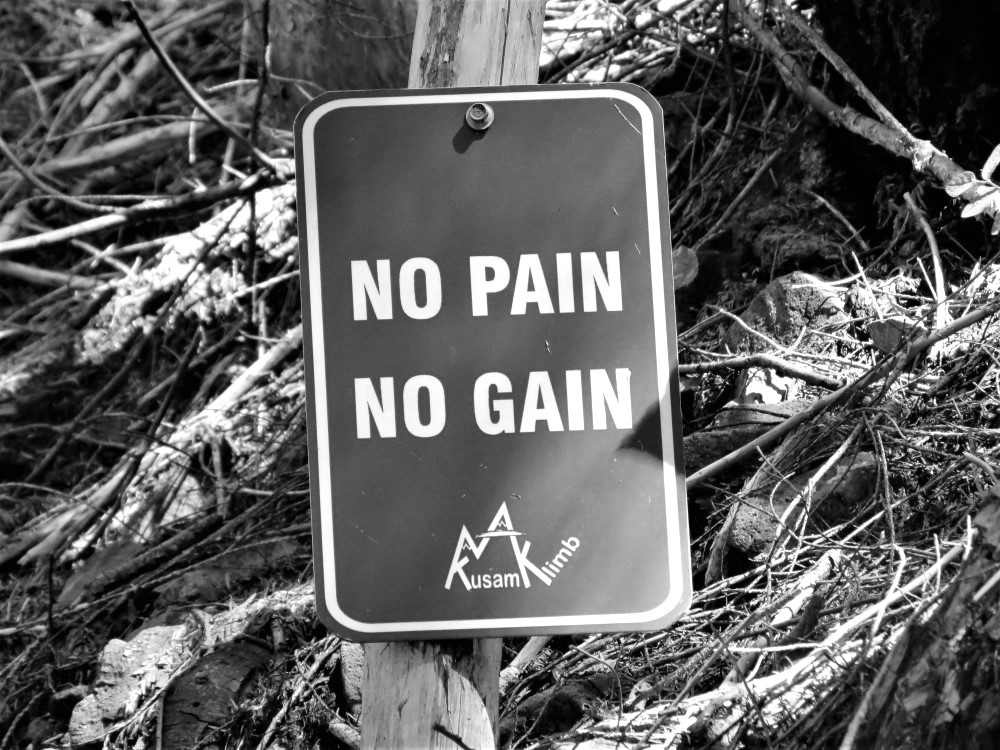
I chose the Kusam Klimb trail. The Mount Kusam Trail is a wild and rugged 23 km loop heading up and over Mount H’Kusam and down the Stowe Creek watershed. Starting at sea level, hikers pass through some of the most spectacular scenery on Vancouver Island, with views of mountain peaks and the Johnstone Strait as they negotiate their way over the well-developed trail. While the trail is open for year-round hiking, an organized event is held once per year on the summer solstice. The Kusam Klimb draws participants from around the world, hoping to conquer the mountain! We have a saying about this trail. Are you tough enough? Well, are you?
My knee, before it was replaced, kept me from hiking this trail. Now here it was, a year after my knee replacement, and I began to think about checking it out. I asked my son to join me, but he said he was not feeling well, so I thought, let’s solo the hill for my first climb. I left around 8 am and proceeded to travel up the trail. As I hiked up, I was taken in by the incredible views. The higher I got, the more I could see. Checkpoint one was easily reached, and the route to checkpoint two was pretty easy to traverse, but after this, the trail began to get steep, and I was quite happy to see that ropes were in place to help with getting up the steep parts; some are very steep.
I thoroughly enjoyed the hike and spent time taking any side trails that went out to viewpoints. These viewpoints are well worth the hike to see, and I suggest that you also take time to visit them. By the time you are close to reaching the top, you find yourself walking in a beautiful sub-alpine forest where bird life is abundant, including many sooty grouse. As you reach the pass that leads to the far side of the mountain, you will see a side trail that will take you right up to the peak of the mountain. I did not take it at this time, but I plan on going back to hike this trail.
From the pass, you can hike out to the top of a bluff that overlooks the Sayward Valley; this is a must-see. As you sit on the edge, you can look down into a bowl that has a beautiful little alpine lake sitting there like a blue jewel and beyond this is the view of the valley located far below you. The lake is used by rough- skinned newts as a mating area, and sometimes you can see them in the thousands swimming here. I attempted to contact my son before I went over the top to let him know I was doing the whole trail, but got no answer.
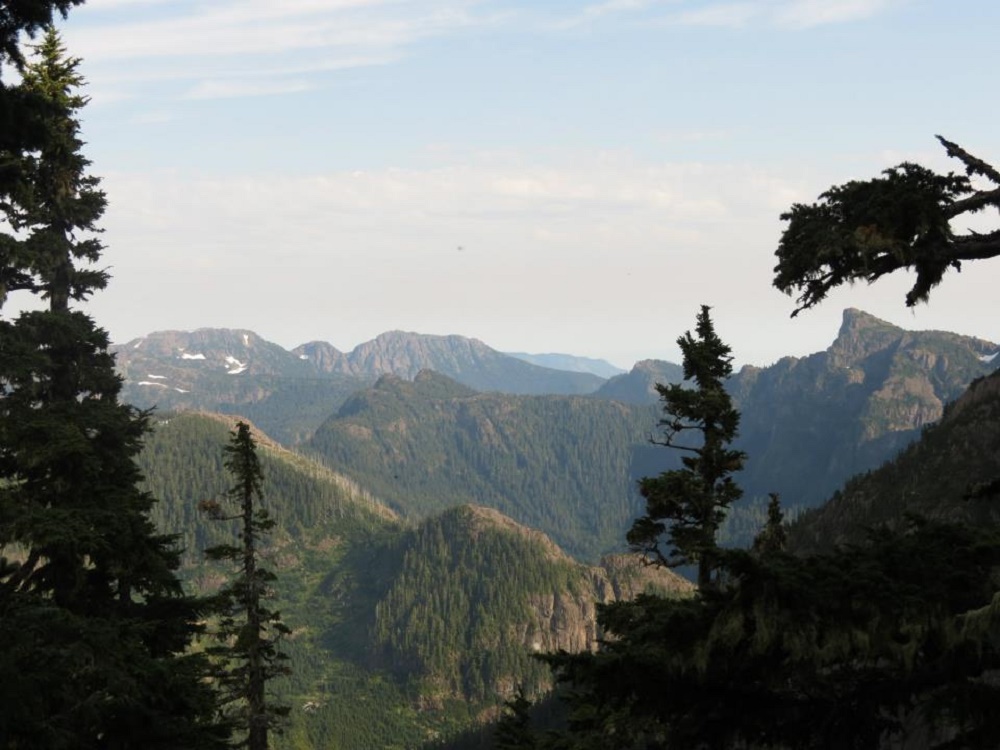
After hiking down to the lake, you hike the trail that takes you around the lake and then back up to another
pass that goes up and then leads you down the Stowe Creek watershed and eventually back to the bottom of the trail. This part of the trail is about 15 km and uses old roads and soft forest trails where you have a good chance of seeing black bears, elk, deer, and lots of birds. The whole journey took me 9 hours as I was
taking my time; my new knee performed incredibly well.
During the official Kusam Klimb, the runners, and yes, I mean runners, as the lead racers indeed do run the trail, take between 2 and 3 hours to complete the race; the record for men is set at 2 hours and 13 minutes, and the record for the fastest female is set at 2 hours and 43 minutes. These racers are top-of-the-line participants who train year-round for this race.
When I arrived back at my van, I saw there was a card stuck in my door window; it was an RCMP card with a note on the back to please contact them as soon as possible. All kinds of thoughts were going through my mind: was there a family problem, a death? I did not know as I proceeded to drive down from the trailhead. As I arrived at the turnoff, I saw there were RCMP, Search and Rescue and others getting ready to head up the trail. I asked if someone was lost on the mountain. The head of our detachment said Yes, you are. Seems that my son started to panic about me being gone so long and that he had thoughts of me lying on the trail somewhere with my leg screwed up.
He explained later that he had tried to contact me by radio, as did a few others who were in Sayward and after getting no reply, he did the right thing and called the RCMP, who then called in Search and Rescue. I told him I had tried to reach him as well. We looked at the radios, and I realized that mine had been turned to a different channel somehow in my pack, and I had not noticed.
It all ended well; I was impressed with how fast they had got everyone together to come to find me. Gave me a good feeling that perhaps if there had been a problem, they would have brought me home. There are many mountain trails on the coast, and some of them are extreme. The Kusam Trail is one of these, and if you are going to hike it, let someone know when you should be out. That way, you can help them to find you by reporting that you are late. Could save your life.
Moving to the valley
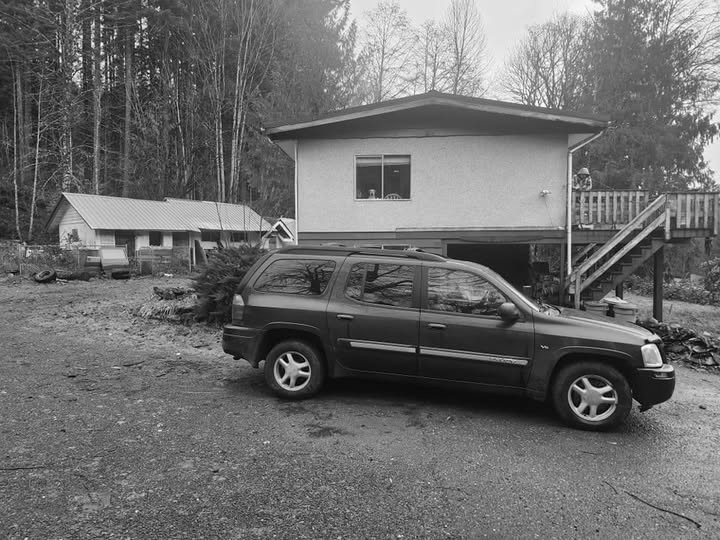
We were still living in the village, but we were not happy with the realtor who looked after our lease. When our 5-year lease was coming to its end, they told us our rent was going to more than double, going from 1200 to 2500. I gave a more reasonable offer, but they flatly refused it; They said to pay the new rent or leave so they could sell the place. We decided to leave, and they put the house up for sale. The high rent was a way of getting us to leave so the house could be sold. Unfortunately for them was the complete shutdown due to COVID. The house did not sell. There is a regulation in law that says when a family is evicted so the home could be sold, they could not rent it out for 12 months. The house sat empty, mould formed, and this prevented it from selling even after the pandemic. They had to have it repaired before it sold. I felt sorry for the owner, but they brought this on themselves.
Our new house sat on an acre of land, surrounded by forests. True privacy. The new landlord has become a friend, and believe me when I say, she is pretty awesome. When we moved in, the house had been unoccupied for several years and needed some work; I had to replumb the water system and rewire some of the electrical. The grounds were overgrown, and the inside of the house needed paint. The wood heater needed to be updated and inspected. Once this was done, I added a 750-gallon cistern and water filter to the well system to get us through the summer months. A new water pump and pressure tank were added to the whole water system. A new hot water tank was put in. All was good to go now.
The Stroke
Things were good, but my health was giving me trouble; I was having a hard time adjusting my blood sugars, and this was stressing out the rest of my body. On a visit to my doctor, he suggested that I try out pot gummies instead of smoking it. I thought it might be a good move, so I quit smoking pot and went on gummies. One day, I did a strong gummy and sat down to watch a movie. I started to feel strange, thinking this was the strong gummy. I decided to just ride it out.
Suddenly, I found myself in a field and unable to understand how I got there. I was confused. There was a black shadow looming over me; I saw it was a very large bird-like creature that looked a lot like a black-robed priest with wings and eagle-like claws where its feet should be. It had a wicked-looking beak for a nose and deep-set fire-red eyes. I started to run, scared shitless. The creature grabbed me by my shoulders, digging its claws in deep. I was trying to get loose as this thing began to lift me. I was digging my feet into the ground and fighting to get loose. Then, just as my feet left the ground, I felt hands on my ankles. They were coming out of the ground; they were people. As the first one was lifted, more hands reached up to hold onto the others. I knew without a doubt that they were my ancestors. I was pounding on the claws in my shoulder and screaming in pain as I fought to get loose. Then I saw a huge flock of Ravens that almost blocked the sun from the sky, and as they reached us, they started to attack the beast. Suddenly, without warning, there was a soundless, bright explosion of light, then I blacked out.
When I came to, I was now lying back in the field, trying to figure out what was going on. Off in the distance, I could hear someone calling my name; this kept getting louder. The field disappeared, and I found myself on my couch with my wife, Gina, looking down at me. She was asking if I was ok and she indicated my crotch area. As I looked down, I could see that I had pissed my pants. I was still totally confused and not sure what the hell was going on. I managed to get into the bathroom and cleaned myself up; everything seemed to be working except my left arm was weak, making it a struggle to get a clean T-shirt on. I got back out to the couch and sat there, still confused. My wife asked me to lift my arms, but this was too difficult to do, and I failed to understand why we were doing it. She realized that I was having a stroke. An ambulance was called, and off to the hospital I went.
The next day, I did not know where I was, and doctors and nurses kept coming in to lift my arm, then let it go where it would drop like dead weight. I had no feelings in the left side of my body. On the second day, they informed me that they may need to make arrangements to move me to a rehab location in Vancouver where I would begin to learn how to deal with it all. I did not like this. On the third day, as a nurse lifted my arm, I felt a very slight hesitation before my arm dropped. I told her, but she said it was my imagination. I knew it was real. So after she left the room, I got myself out of bed. Standing on my good leg, I began to do knee bends. The nurse came in and said What are you doing, I said back to her that I was not going to rehab. So the doctor set me up to meet a physiotherapist that afternoon; she began working with me. Four days later, I was walking around using a walker. My arm was still not working very well, but my left leg was beginning to work. Five days later, I was back at home; a week after that, I went out and cut a cord of wood for the house.
There were so many places on the left side of my body that had no feeling, but the parts with feeling were allowing me to control the other parts; to this day, I am still numb in many spots. I tend to trip on my feet now and then and drop things from my left hand, but all in all, things are manageable.
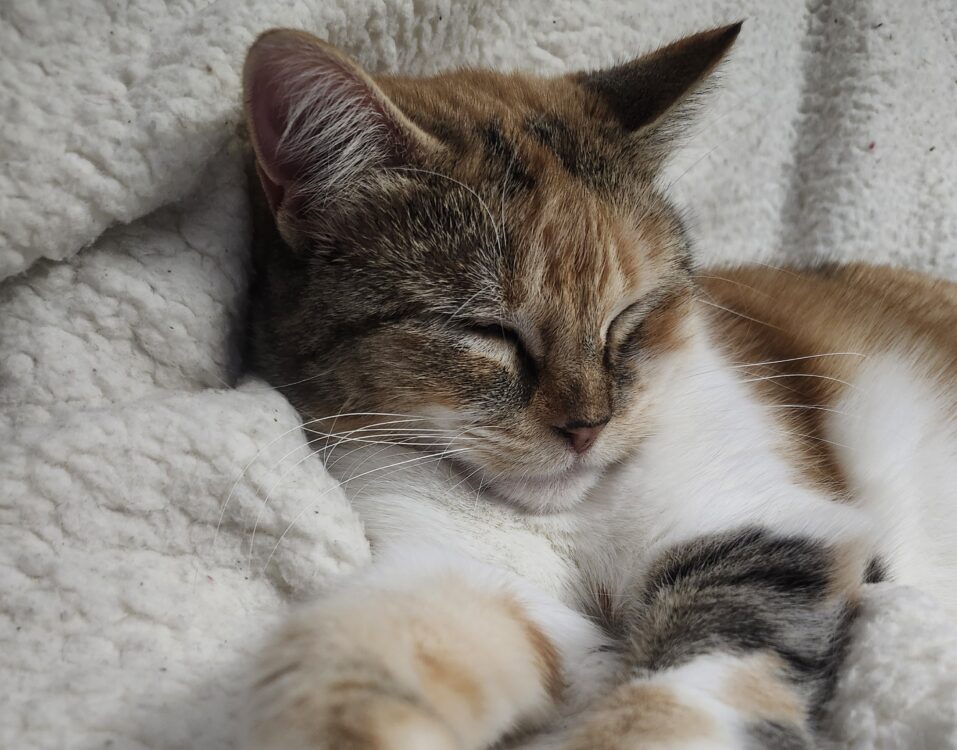
While recovering from my stroke, my older male cat came home with a stray cat looking for help. She took up residence in an old car out back. I took it upon myself to help this cat out; at first, I could not get closer than 20 or so feet. But I kept feeding her, and as she would eat, I would talk to her. After many months of this, she was finally allowing me to pat her while she ate. Not long after this, she moved into our basement, but would only use the window to enter and exit. I had a table right at the window, and her bed and food were placed there. Another six months went by when one evening, she showed up at our upstairs living room window. She began to use it. When in the house, she always sat on my lap, where I believe she felt safe. She and I are best friends now. I still wonder what her story is and why she was so fearful of people.
As I look back on it, I realize I may have saved her, but she also saved me. I was pretty depressed after my stroke and having a hard time with not being able to do things I used to take for granted, little things like not being able to control a knife and fork well enough to cut my meat at dinner, although it was something I had done all my life. There were, and still are, many limitations in things I used to do with ease. But this cat that I named Caili seemed to help me forget, and she always brings a smile to my face.
The Project
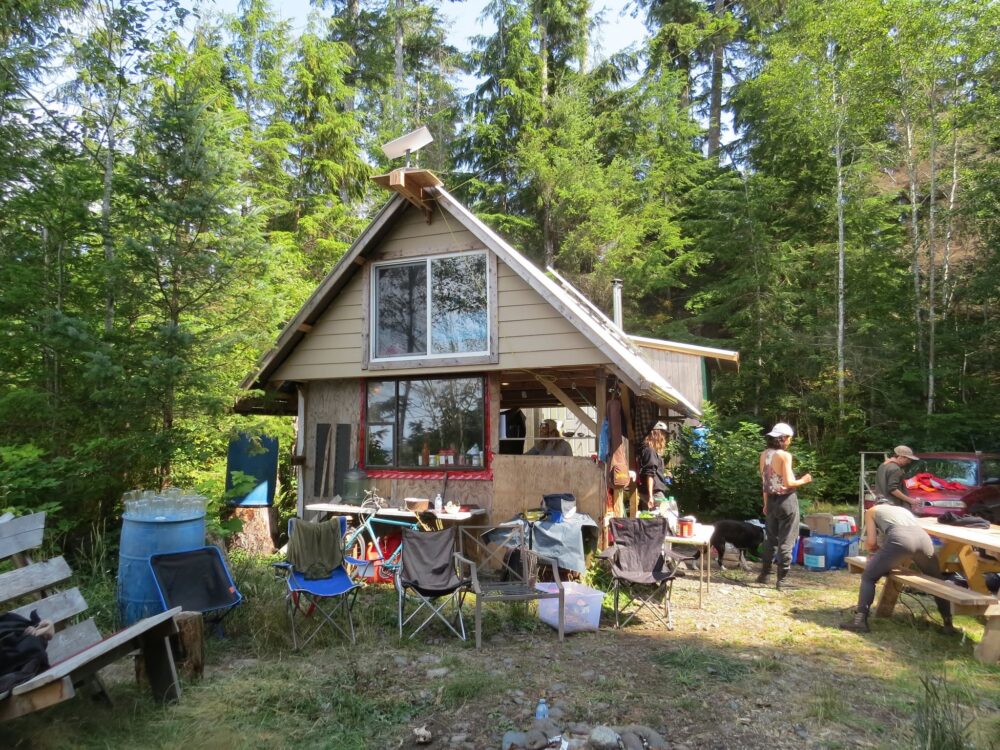
After healing from the stroke as best I could, I was invited to help with a project to bring both a stable power source and running water to a cabin located in the Adam River Estuary. This cabin is part of a landback project by the Ma’amtagila people, who have occupied this area for thousands of years. I watched this project proceed by visiting every six months or so. I was highly impressed by how the endeavour was proceeding and by the people who were doing the work. These were young people who mostly came from marginalized communities and found a certain peace working out at the cabin site. My wife and I were so glad to have them all; they were an inspiration to us.
The driving force behind this landback occupation was spearheaded by a wonderful old soul who touched all with her kindness and her knowledge- not just land knowledge, but she understood the rules of protocol. Her name was Tsas Umbas. She was my friend.