
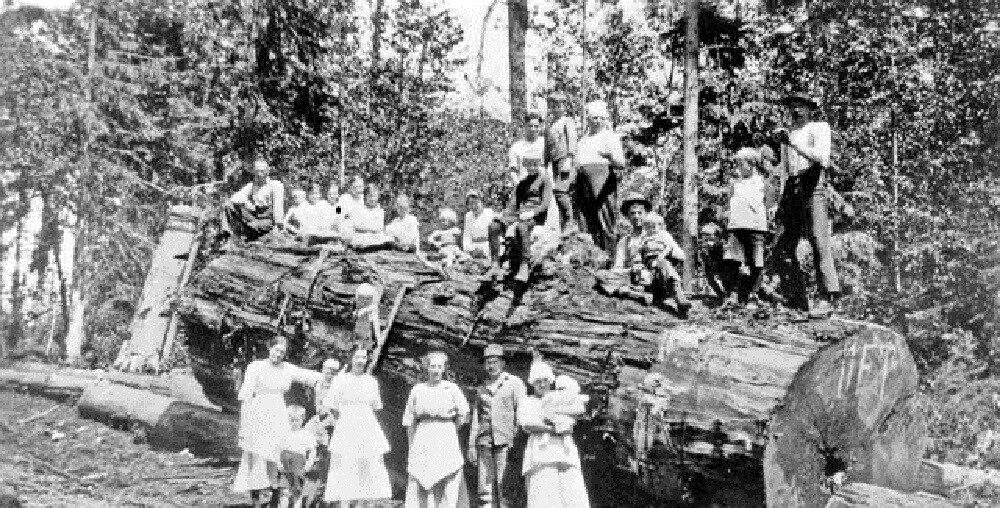
In the fall of 75, I was employed by a logging company on Hardwick Island. I had been in a few camps by then, mostly modern trailers set for the various needs of the logger. This camp was different and was pretty cool; it was old school. It was like being in the forties. For example, in the wash house, there was one set of taps. Then there was a long wooden counter that ran down along the wall. There were round holes cut into this countertop with mirrors on the wall above. On the other wall were metal wash basins hanging. You took one down, filled it at the taps and moved to one of the holes in the board that fit these basins. When you were done with your washing up, you poured the contents down the drain at the taps and rinsed the basin before hanging it back on the wall.
You were called to meals by a big triangular steel plate that hung outside the door, where you were always served up man-sized meals. I was just a kid of 20 during my time here, but I still remember the old guys, upon seeing my plate at dinner time, quite often commenting about where the hell I put it all.
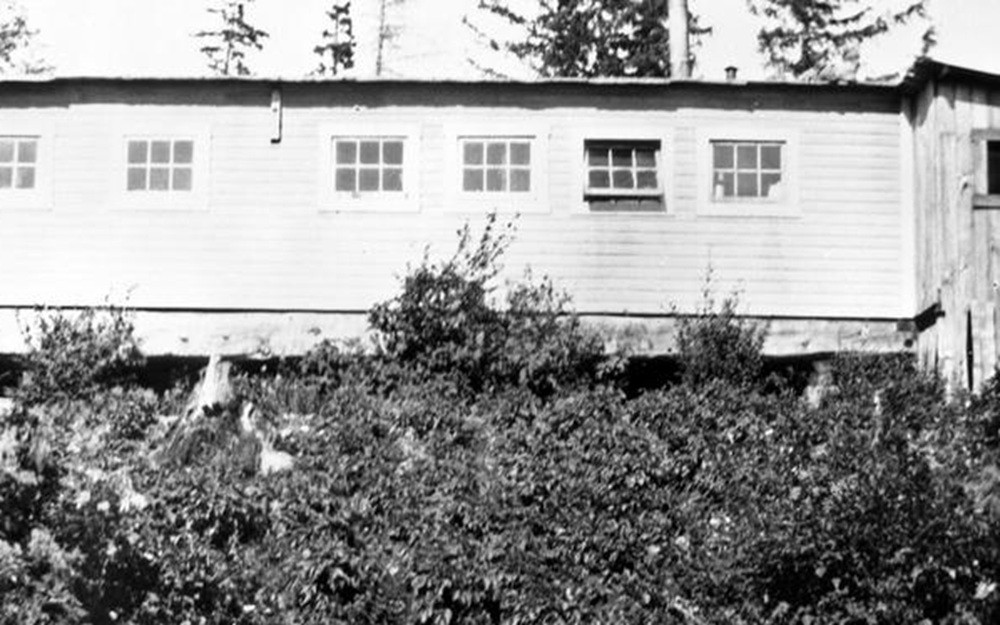
Our bunkhouses were big, octagonal buildings. All the bunks were on the outside, by the walls, with tables and chairs arranged around a central stove, making up the inner part of the room. My first night in camp, I got some really bad leg cramps around 2 am. All the men in my hut were old-time loggers. They all woke up from my groaning, and they gathered around me, telling me how they would beat these cramps. Several told me that they would wear pantyhose, and this worked well. I never tried the pantyhose, but in our crummys was a dispenser for salt tablets. I started using them, and the leg cramps were gone. I can still see the oldtimers as they gathered around me that night, and from then on, they just called me the kid. Seems to be my nickname wherever I went.
One day, as we were heading up the hill to go to work, all of a sudden the fellers came careening around a corner hell-bent for leather and came to a sliding halt beside our crummy. Your donkeys on fire, one was hollering, so we picked up the pace and got up the hill as fast as we could, and sure enough, there was our yarder, burning out of control. The chaser had built a fire the day before in the landing to keep warm, and although he had put it out before we left the site, it must have gone underground and come alive during the night. Landings were usually just pushed-up piles of wood and dirt. It was a total loss. The insurance company only covered the machine, but not the pipe, as it sustained very little damage. I assumed we would all be laid off until the new machine made it here, and the pipe moved onto the new rig. Instead of laying off the crew, they put us to various jobs. Although I was not involved with the job, it must have been quite the project, putting the new yarder onto the old pipe.
I was put in charge of operating the rock crusher at the pit. This quarry consisted of a big rock wall at the end, where we would blast rock loose to feed the crusher. This jaw crusher could crunch up rocks as big as trucks and put out any size of gravel that was needed with just one adjustment.
It was a scary old machine built back in the days of crank starts. The first thing you had to do in the morning was start an old Model T motor by cranking it over by hand. Now, this crank could take your arm off when it kicked back, and the crank handle sometimes would come flying off and bounce around in the engine room, and it was always tough to start. Once it was running, you would use it to turn over the big diesel engine that ran the crusher. There was a small flywheel on the diesel engine and a big one on the Model T. There was a belt between the two that was slack until you used a tensioner pulley that was on a lever; you would hold it tight to turn over the crusher motor, a pretty cool system. Sometimes the Model T would stall, and I would need to do it all over again. After getting the big motor running, you would slacken the belt and turn off the Model T until the next day, when you would go through the same process.
If a big rock got stuck in the jaws, I would go out to the bin and, using a full-length rock drill steel, I would move the rock around until the jaws started to grab it. You had to do this quite often. Most times, it was uneventful. There was one time when I was doing this that the jaws caught the steel, pulling the steel forward. This caused my fingers to get caught against the edge of the hopper and the steel. As I let the steel go in pain, it came back and hammered me in the forehead, damn near knocking me out. I fell onto the rocks that filled the crusher receptacle. It’s amazing how fast I got back to my feet and out of the hopper. I retrieved the drill steel, but my hard hat went through and was pretty mangled; it was my favourite tin hat. As I said, this was a scary old machine. This old machine was retired not long after I was running it. From my understanding, you can still see where it rests along the road going out of camp.

One day, a road-building contractor who was working for the logging company asked me to work for him on his rock drill. This was an awesome job. Drill holes for a few days, load with powder, and blow the shit out of stuff. always did enjoy blowing things up, so this appealed to me. So I jumped right at it. Over the next few months, I got pretty good at it. Blew up a lot of rock faces. Built a lot of roads. I can remember times of sitting out on the boom, which was extended out and up, right against the rock face where we had drilled holes. I would have several cases of dynamite between my legs and blasting caps in my mouth. I would then load and wire up holes to blow the rock away. It was a pretty awesome job. I worked there until the winter shutdown. Built lots of the roads on the Island.
Today, it is impossible to think of Hardwicke Island without thinking of the Bendicksons; the family has been part of the island’s history for the past 90 years. I know it is one of my good memories from a different time indeed.
There are many more stories in the comments below from people who were touched by this Island in one way or another.
My aunt and uncle lived on Hardwicke island in the 60s , I spent sometime there one summer . My aunt and uncle were Gordie and Loretta Schoonarts and my uncle worked for the Bendicksons.
My grandparents lived further down the island from the camp ( Jack and Rose Smith ) and my grandfather worked for Bendicksons for many years. I went to the one room school , spent summers swimming and enjoying life.In later years people always said..No TV you must have been bored but I never was.
Hardwicke island will always remain close to my heart. Everybody knew everybody else. Further down from my grandparents house is where the Edwards lived then us and the next house was old Jeff.
Between us and the camp were the Carmichaels and Old Berts house. I guess that was about it for those who lived on the island but not in the camp.
It was a wonderful life and I will never forget people like Hug Carmichaelwho had a heart the size of Texas. A different time, a different life and amazing memories..
Belle Straker.
We would love to hear more about Jack and Rose and your family memories
Judy Bendickson Erickson
Hardwicke Island
Hello Judy;
The happiest and most carefree days of my life were spent on Hardwicke and my greatest regret is that my sons will never know or enjoy the Hardwicke Island experience. After I moved away we would go back to visit Gram and Gramps (Rose & Jack Smith ) and we always arrived tired but ready to eat because we knew Gram would have plenty of venison steaks and a pot of hot coffee waiting for us. My grandfather was the gentlest and kindest man and I miss him terribly. So many amazing memories. I am now a great grandmother and still cherish those years.
sounds like you have some great memories
Wonderful to hear… I am Ruth edward… granddaughter of Jim and Alice edward. My aunty hug married Mac Carmichael… nice to hear family history…
Yes the Bendickson family is very much still part of Hardwicke Island, non as full time residents but mostly using their homes on a part time basis as recreational properties. In the summer of 2018 we had a family gathering to celebrate the centennial of the family arriving from Jervis Inlet as mentioned in the above article. I started my working life on the Island in the early sixties, first tree planting, then helping with log booming and then on road construction. I also worked with the rock crusher as mentioned which is now becoming hidden in the new growth where last used. lots of history on the Island.
Yes Darlene! A few do and other family members from the camp days. Also some “new” but long time residents (40 years) I work on Hardwicke now. It is a pretty cool place. Amazing that we have sustainabley logged this island for over 100 years. I do believe the crusher abandoned in the bush is the crusher spoke of in this memory!
Fascinating article. In around 1918-1920- my maternal swedish grandma, Selma Halvorsen arrived on Hardwicke Island with her two young sons. She had recently been widowed , her husband Sigurd Halvorsen died in 1918 from the Spanish Flu, while they were living in Revelstoke. So Selma packed up and headed for a cooking job on Hardwicke Island. She would have been about 24 years old . Our family thinks it was her husband’s Norwegian connections and the good reputation of the Bendickson’s that led her there. Selma hailed from around the 64th parallel on the eastern coast of Sweden. She was no stranger to hard work and rough conditions. She did leave after a short while, landed in Vancouver, and remarried there, and raised a large family during the depression years, my Mom being one of them. I wonder if the Bendickson family lives on at Hardwicke Island?
Hey Darlene,
I think it’s my 2xgreat Uncle is Sigurd Halvorson. I just happened to be looking at their wedding picture. Googled Selma Erikson. And your comment brought me. Sigurd is my Great Grandmothers Norwegian Brother.