
(Alloclavaria purpurea)
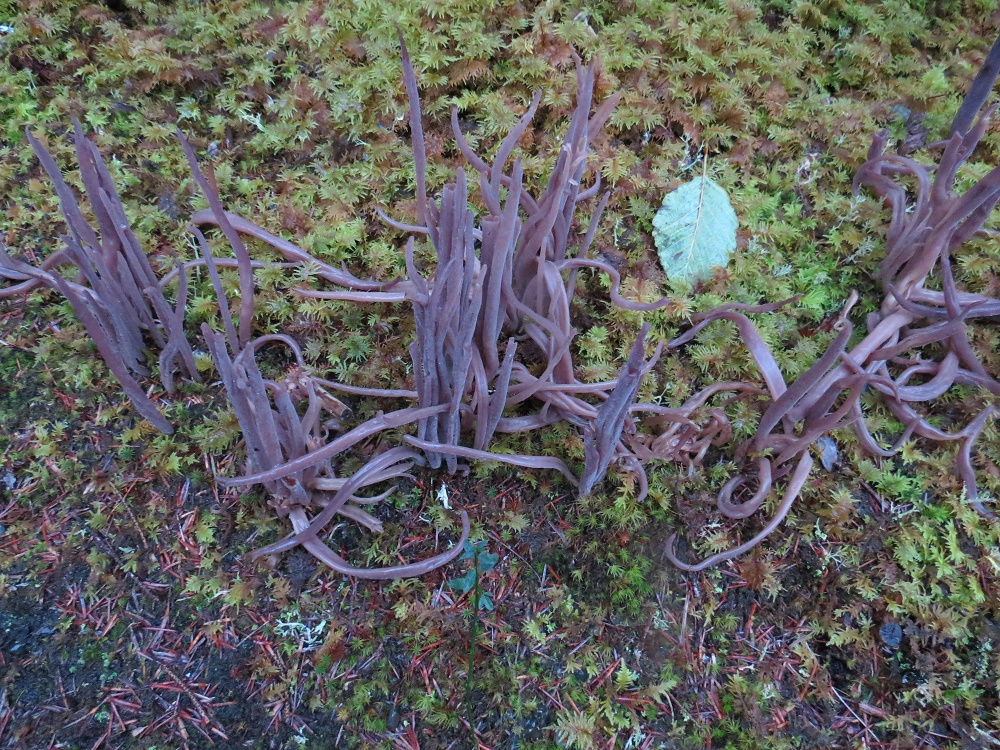
Purple Fairy Club, with its dull purple colours and densely packed, non-branching fruiting bodies, is distinctive enough that you will probably not need to use a microscope or a DNA sequencer to identify the mushroom successfully.
Traditionally presumed to be saprobic, but new studies suggest the possibility that it is associated with mosses, I wonder whether it might be associated with spruce,s as I always see them growing in tight clusters in conifer forests that contain lots of spruce trees. They are widely distributed in northern, montane, and western North America. I see them quite often on Vancouver Island.
They can reach heights of up to 15 cm and are up to 6 mm wide. They are spindle-shaped, unbranched, sometimes somewhat flattened, or with a groove or a twist, and very pretty to the eye. At one time, it was known as Clavaria purpura; it has now been moved to its own genus as a result of phylogenetic analysis, and it is now officially known as Alloclavaria puppurea.

When you’re out walking in a dark mossy forest, keep your eyes on the lookout for this purple beauty. I don’t often see it, but in my last sighting, just last fall, I had the pleasure of seeing a huge grouping of them alongside a trail in Sayward, BC. Fairy clubs were coming up on both sides of the trail for about 50 meters; it was such a wonder.
Although the Purple Fairy Club Mushroom is edible, it has a dull fishy flavour and is not very tasty. I would just enjoy any sighting you see, take some photos, and leave it in the ground.