
I have always enjoyed getting out and hiking in the forests of Vancouver Island. We do live in one of the most amazing places on the planet. Our island is the largest island on the west coast of North America. It is a little over 32,000 square kilometres in size and is 460 kilometres in length, 35 to 80 kilometres wide. It is separated from the BC Coast by several straits, the Juan De Fuca Strait on the south island, the Johnstone Strait on the central island and the Queen Charlotte Strait on the north island.
The west coast of the island is a wet and wild land of wind, covered by (historically) ancient forests of giant trees; some of the world’s tallest trees can be found in these forests today. This side of the island is breached by many deep inlets surrounded by high mountains that seem to spring from the sea and go straight up to the sky. The average height of these mountains is 800 metres, with some reaching upwards of 2200 metres.
The Pacific storms that pound the west coast throughout the year, and more so in the winter months,s are laden with moisture that must be dropped to rise up and over the Island mountains. So the west coast receives much more rain than the east coast of the island. Truly a rainforest. The West Coast is spotted with small islands, hot springs, and many large rivers that reach the sea there. An incredibly beautiful place. A place of waterfalls and hidden lakes. A place of mists and trees. A place of wonder.
The east coast of the Island, from Campbell River down to the south Island, has a very different type of terrain with broad, gently sloping shelves that go from the sea to the eastern slopes of the Island mountains. Deep, slow-moving, nutrient-rich rivers that are teeming with fish empty into the sea, building deltas of rich farmland.
Most of the island’s people live from Campbell River down the east coast of the island to Victoria, including the south tip of the Island. Victoria is the Capital of B.C. and has an economy based both on Government employment and tourism, as well as a minimal amount of resource-based industries. There is a strong agricultural presence on the east coast of the Island, and dairy farms dot the South Island.
The north end of the island is still very much resource-based, with logging, mining, and fishing, and the spin-off industries being the main form of employment. Tourism is starting to make a marked increase in the tax bases of local communities, and I am sure it will continue to have an increase in these economies in the future. Some communities are beginning to fully embrace tourism with incredible results.

Before my brain hemorrhage, I was working independently as a wilderness guide. I would mostly take out photographers looking for a variety of subject matter. A problem had begun to show up; illegal dumpsites were becoming a big issue. No matter what logging road you took out to get to the forest, it was there, and in increasing amounts. People were coming out and dumping in the forests by the truckloads. The photographers that I would guide were always asking why we allowed this to go on. They would say how they could not understand how we could spoil such a wondrous place. I had no answer.
One day, I was riding my mountain bike on a logging road that was only a short distance from my house. As I rode along, I started to take a good look and was appalled at just how much trash there was. So the next day I went back with my camera and made a 15-minute video of the mess. I posted it to YouTube and was surprised to see that it had gone viral overnight with tens of thousands of views. I went back that day and redid the video, but with a request for help cleaning up the mess.
I had always thought about illegal dump sites and cleaning them up, but life always got in the way. After having a brain bleed, I realized that there were no guarantees in life, and it could come to an end in a flash. It was time to stand up and get it done.
Once the video was out, help began to flow in. The Regional District offered dump waivers, a container company gave us two of their biggest containers, and a driver from the company provided delivery and the haul to the dump for free. Another company gave us the use of a front-end loader with an operator. Home Hardware gave us boxes of industrial-strength garbage bags and gloves. A local radio station had me on the air to inspire volunteers to come and lend a hand.

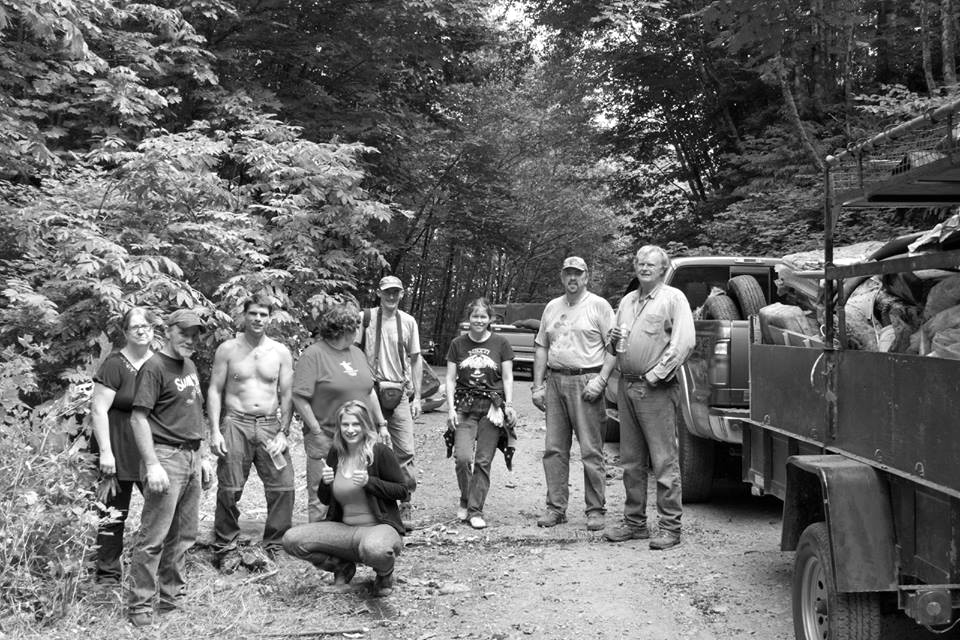
On the first day of the clean-up, so many people showed up to help us that I was overwhelmed by their generosity. Some of the volunteers were too old or unable to help, but they showed up with thermoses of coffee, juice boxes, donuts and sandwiches. There were people stretched all along the road; some were dragging items up the banks to the road, and others were loading trucks and trailers with garbage. This was quite the sight: my daughter was down in a creek, up to her knees in wet baby diapers, loading up bags. My other boys were hauling up old beds and tires. Sometimes they would set up a Tommy Moore pulley and use a truck to pull up large machine tires and barrels. By the end of the second day, we had removed 88,000 pounds of trash. That is 44 tons. I was so proud of everyone.
After we pulled this off, I had meetings with some of the companies and organizations that were involved, and they all agreed to continue helping if I were to start a society to keep on doing cleanups. I talked it out with my family and friends who were involved. They all agreed to keep helping. So the Society of Island Forest Stewards was born. Over the next couple of years, we cleaned up many more tons of trash. The local newspapers and radio stations covered our cleanups, and this helped to keep our base of volunteers, which had now grown to 300, informed about cleanups. Not all would show up, but we always got enough to facilitate a good cleanup. We also started a rumour that we had hidden cameras set up at problem areas. We did try to get the funding to do this, but could not get it done. But you know, just the rumour had the desired effect, and we began to see a reduction in illegal dumping. In the fall of the first year, we were presented with a green award for our work by the regional district. This was presented to us on the late Roderick Haig Brown’s land in Campbell River.
In the fall of our third year, I got a phone call from CBC National News. They wanted to do a story on trash dumping; it would be about all of Canada, and my society would be for the West Coast segment. At first, I was very excited about the story; it would help so much with fundraising. Then I came to realize that they picked this area because it was one of the worst areas in our whole province. Then I was very ashamed.

They started our segment in my art studio, where I was painting a large painting, and we then jumped to my volunteers doing what they do every time we do a cleanup. The whole story is both inspiring, because of the efforts of these people and at the same time, disturbing because of the people who do the dumping. The news story was over 7 minutes in length and was shown on the Thanksgiving 6 o’clock news, right across Canada. You can see it on Google, and search for “Trashing Canada”.
