
(Formica obscuripes)
Thatching Ants are a species of Formica ants that often build huge nests. Their nests are usually large mounds of sticks, leaves, grass, and fir needles. They can also nest in decaying logs.
Anyone who’s walked through the forests and estuaries of Vancouver Island has seen them, the large, often grave-sized mounds of Fir needles and other forest debris that, on a sunny day, are swarming with ants. I( can remember seeing nests that were 10 feet across and these nests were filled with ants.
They are considered both an annoyance and a benefit for various reasons. The annoyance comes because they can severely damage landscaping and can wreak havoc on some fruit trees or saplings, but a benefit because they do more than their fair share in controlling other insects.
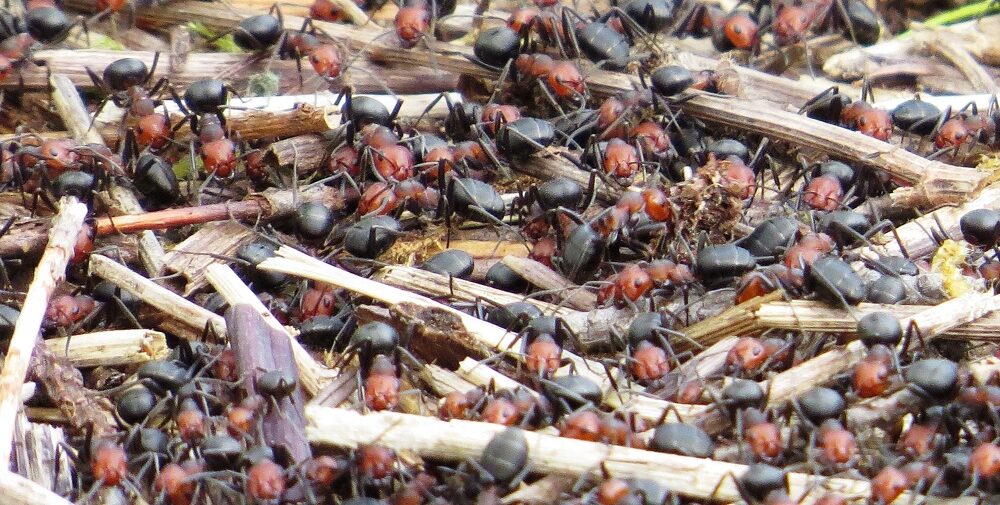
They are social insects that live together in large colonies. They also bring in aphids to their colonies so that they can have the sweet honeydew that is produced by them. The thatching ants will provide food for and protect the aphids from their natural predators, thus creating an overabundance of aphids in some cases.
These ants are either all black or red and black and measure up to 1.5 cm long. The reproductive ants, referred to as males and queens, are the only winged ants. Worker ants have no wings.

Thatching ants should be avoided by humans when possible, as they have a very painful bite and will spray the bite with an acid that causes a burning sting. They can be quite aggressive. Ant colonies start with a single queen ant who will build up her colony from hundreds to thousands as she reproduces.
For the past 16 years, we always have at least 2 active thatching ant nests on our 1-acre property.
I credit them for the relative lack of damaging insects in my garden. They create what I call ‘ant highways’ where their routes from garden to nest are planted with hellebores, cyclamens, trilliums and other plants whose seeds have elaiomes attached . . . myrmecochory.
I do get bitten now and then but I wouldn’t describe the bites as painful.
I live in Surrey BC, and we have a very large mound of ants, probably 2 to 3 feet high, mostly grass and soil it seems. There is a second colony started several metres away. The colony is a neighbourhood asset we think. It is in an area designated as a city park. I wonder if I sent you a picture if you could identify the ants and tell me something about them? Or contact me at 604 597 4323
thatching ants